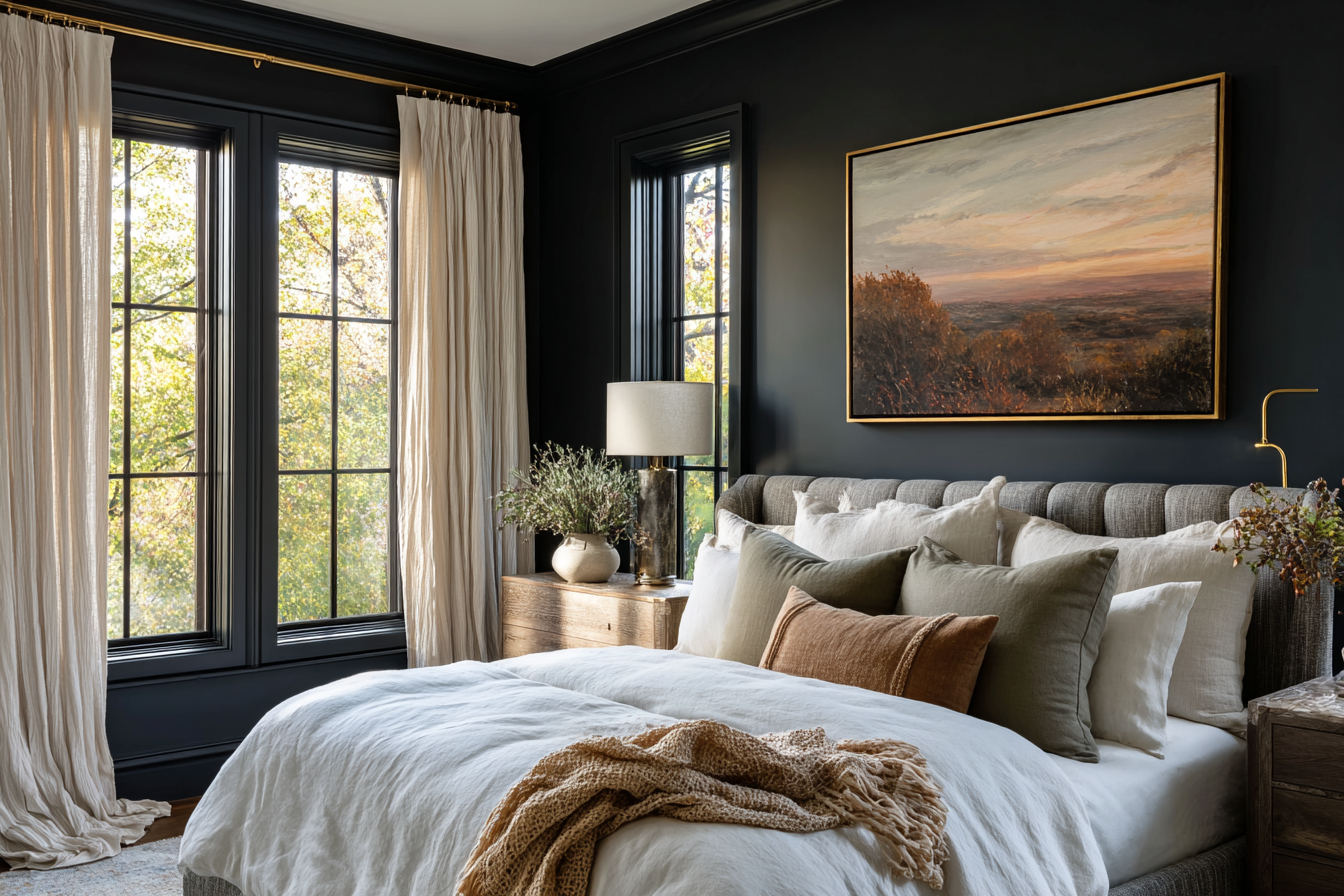
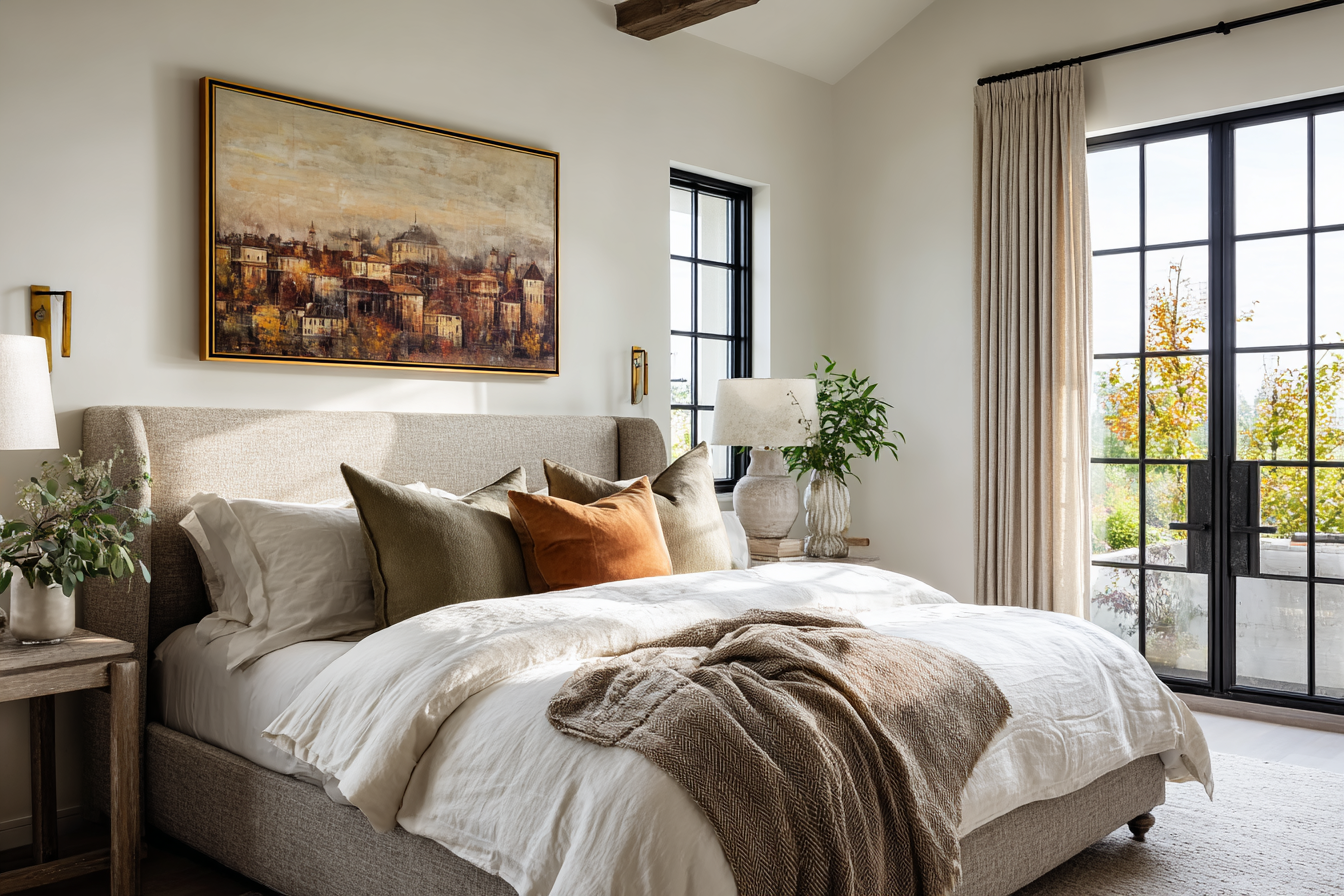
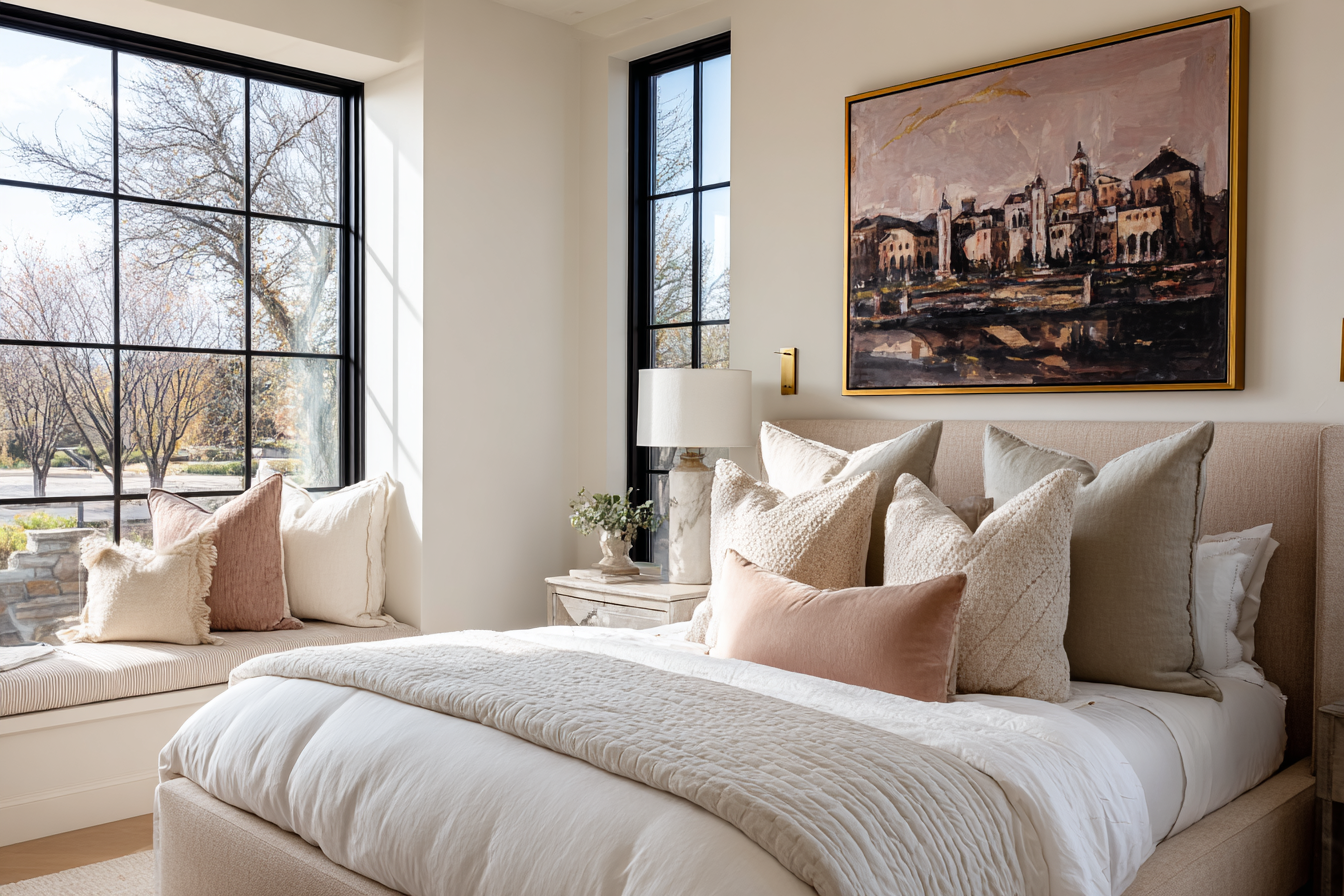
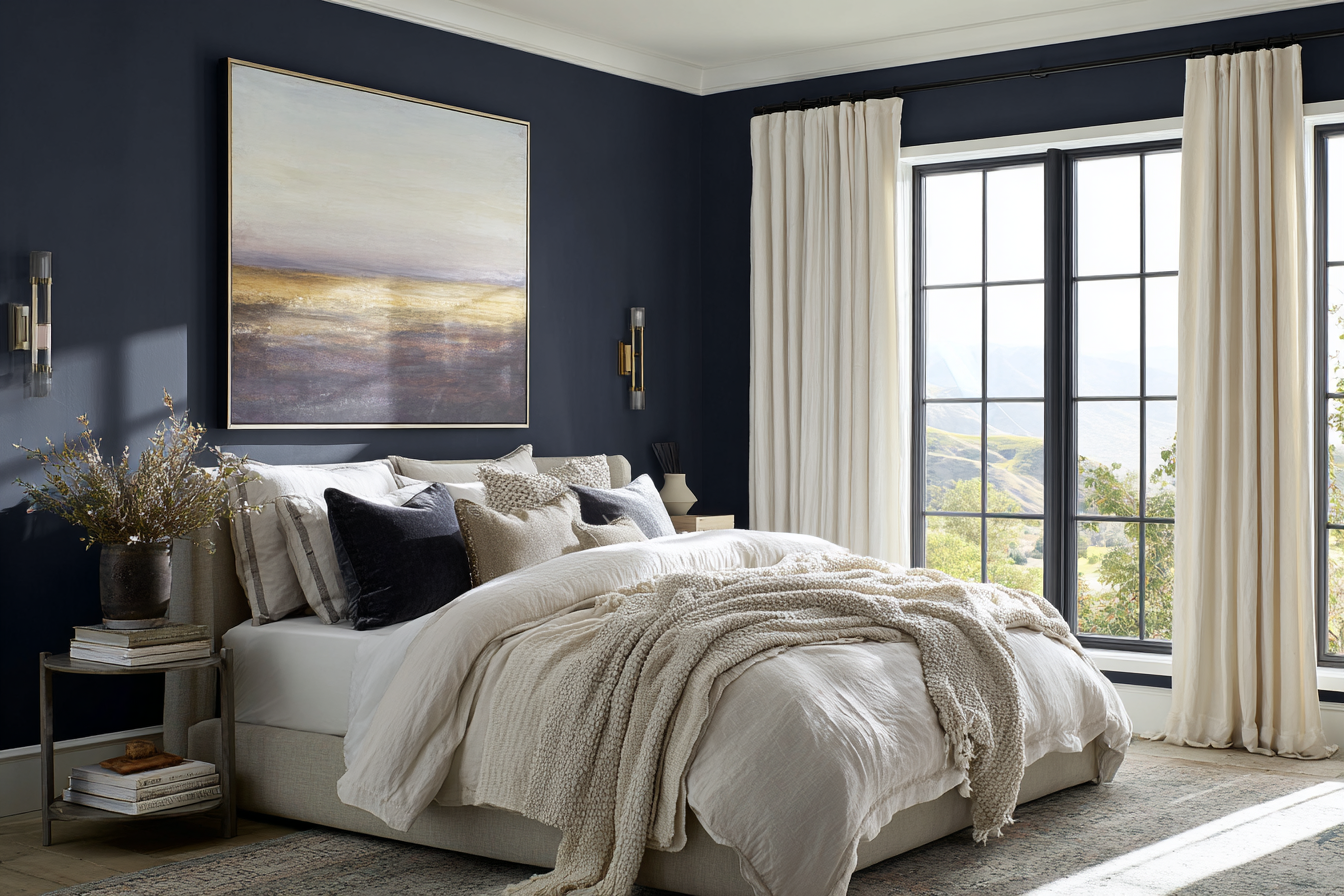
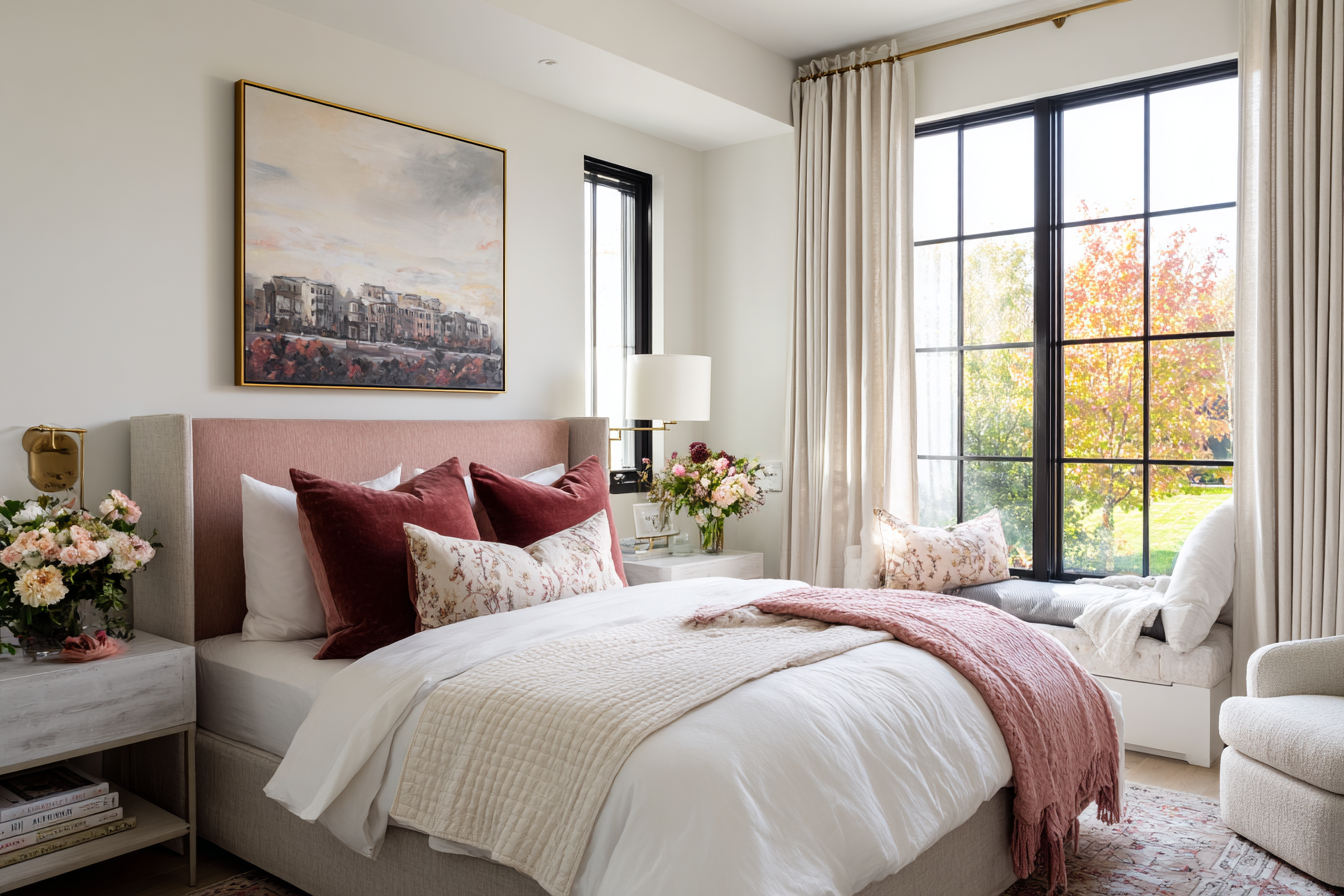
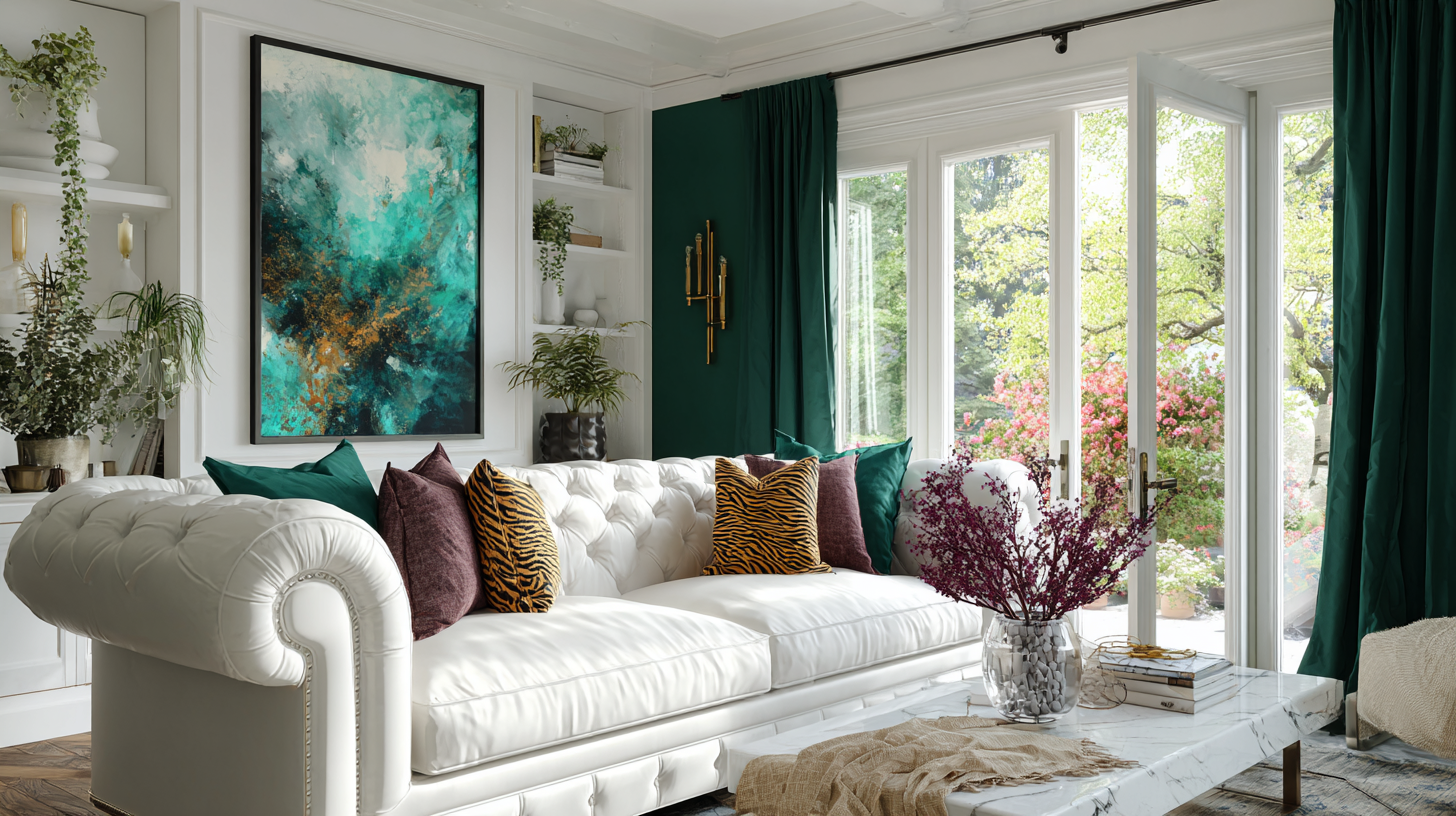
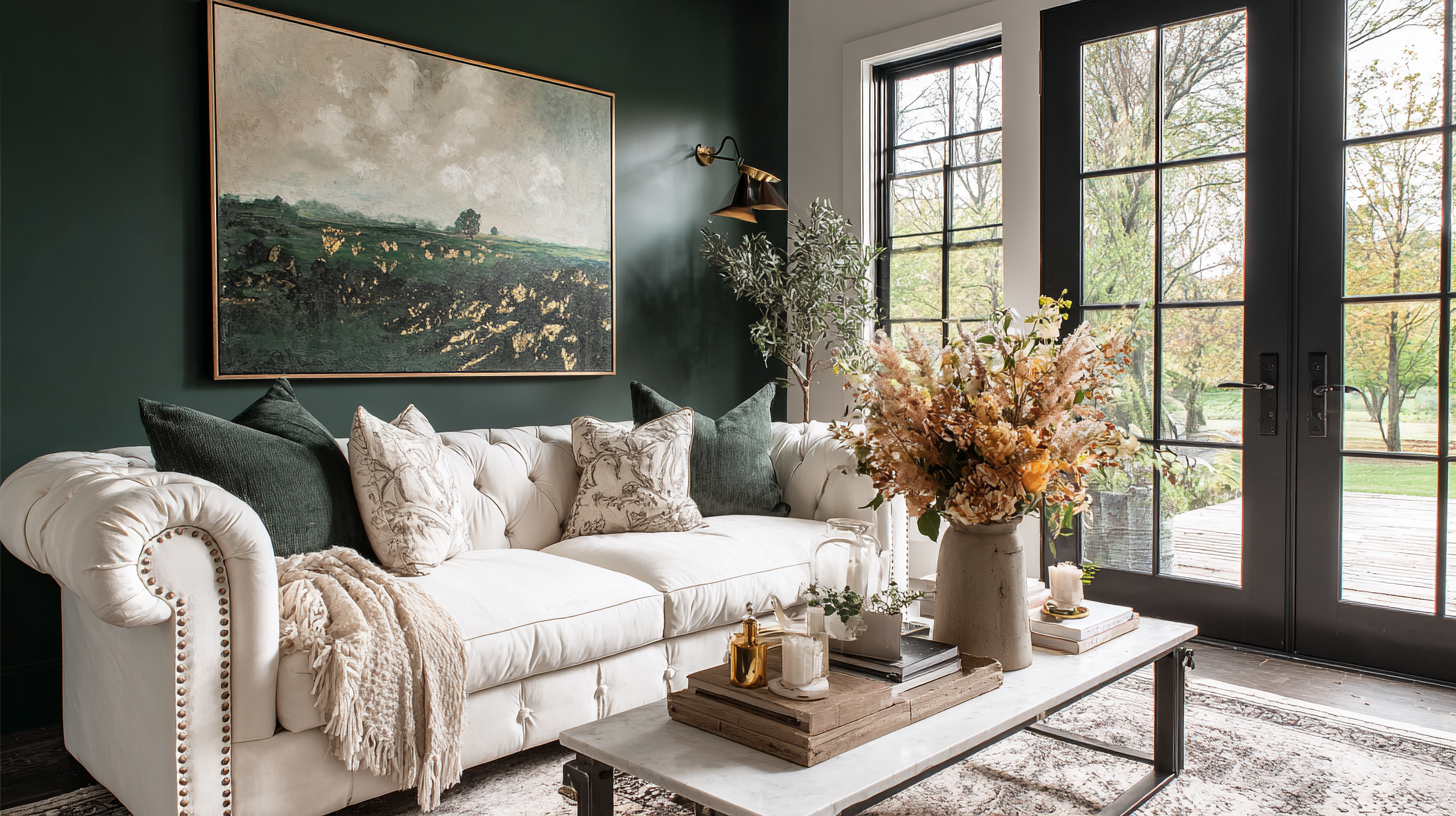
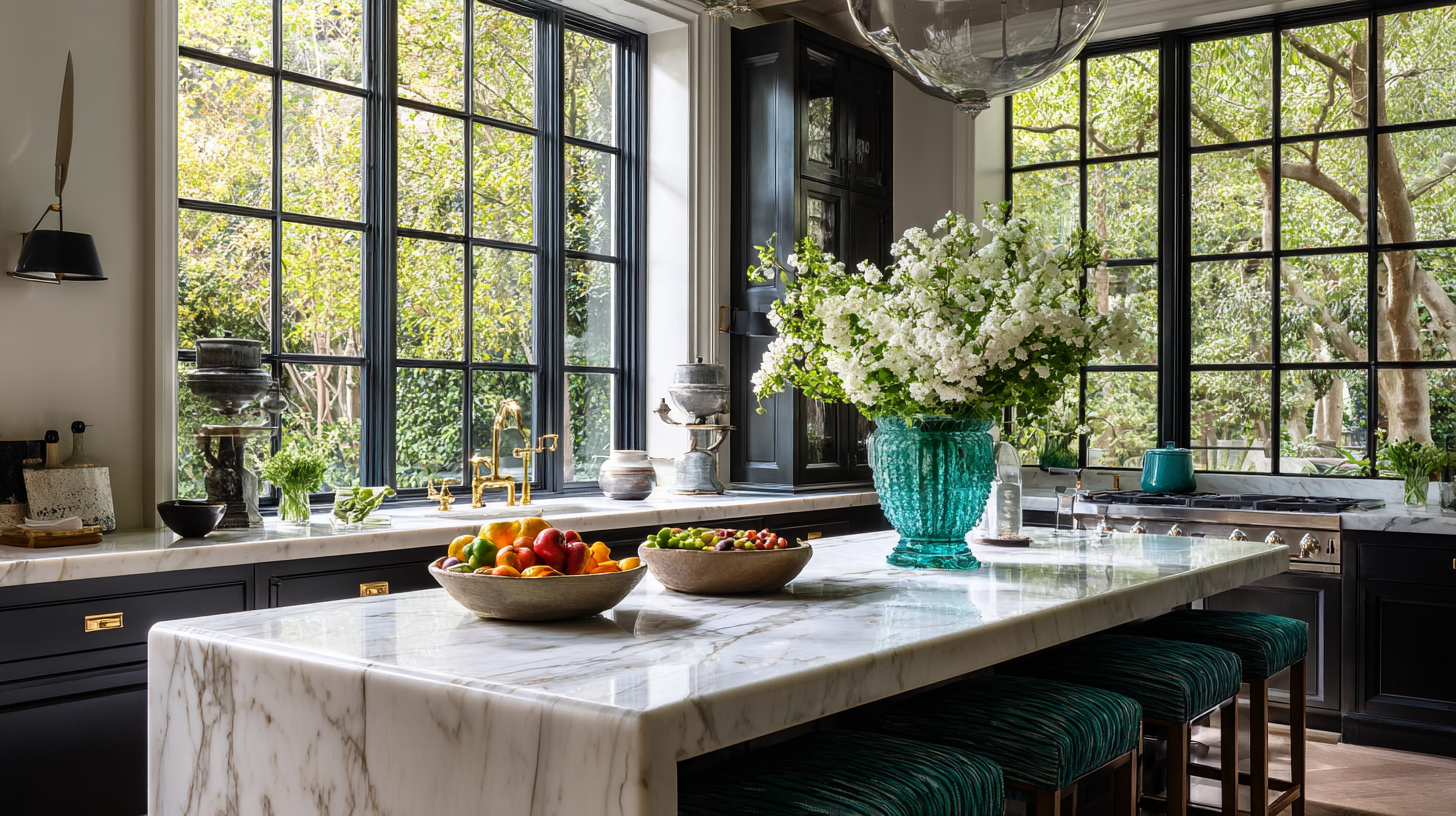
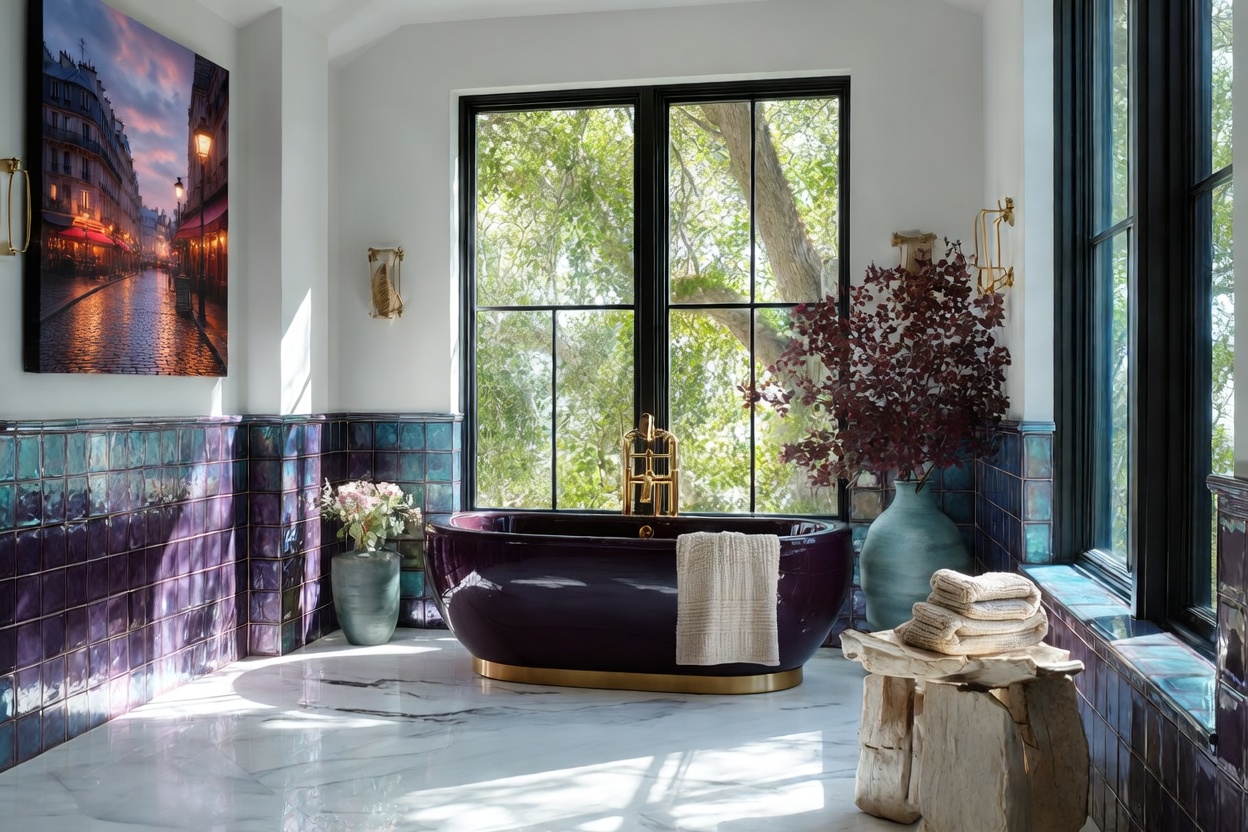
A room is not a collection of furniture. It is a decision about how you want to feel when you walk into it. The art goes on the wall first. The rest of the room answers it.
The Sanctuary
Bedrooms
Gather Here
Living Rooms
The Working Room
Kitchens
Begin & End Here
Bathrooms
Think & Make
Studios & Offices
Between Two Worlds
Verandas & Sunrooms
Sit Down & Stay
Dining Rooms
Bedrooms
The Wildflower Suite
The Appaloosa Room
The Venice Room
The Bromeliad Room
Cadet Song Botanical
Navy Botanical
Cadet Song
Navy Window Seat
Deep Navy
Deep Hunter Green
Linen
Cream & Clay
Classic Navy
White Walls
Deep Cadet Song
Living Rooms
Hunter Green & Dakota Sunset
The Venice Room
Highlander — Curious Lucy
Ash & Baby
Terracotta
Purple Chesterfield
White Walls
Hunter Green
Kitchens
Bright Teal & White Marble
Black Cabinets & White Island
Bathrooms
Parisian Cityscape
Field of Flowers
Sea Glass Vanity
Sea Glass Suite
Sea Glass Walk-In
Deep Purple Glass Tile
White Marble
Glass Tile & Purple
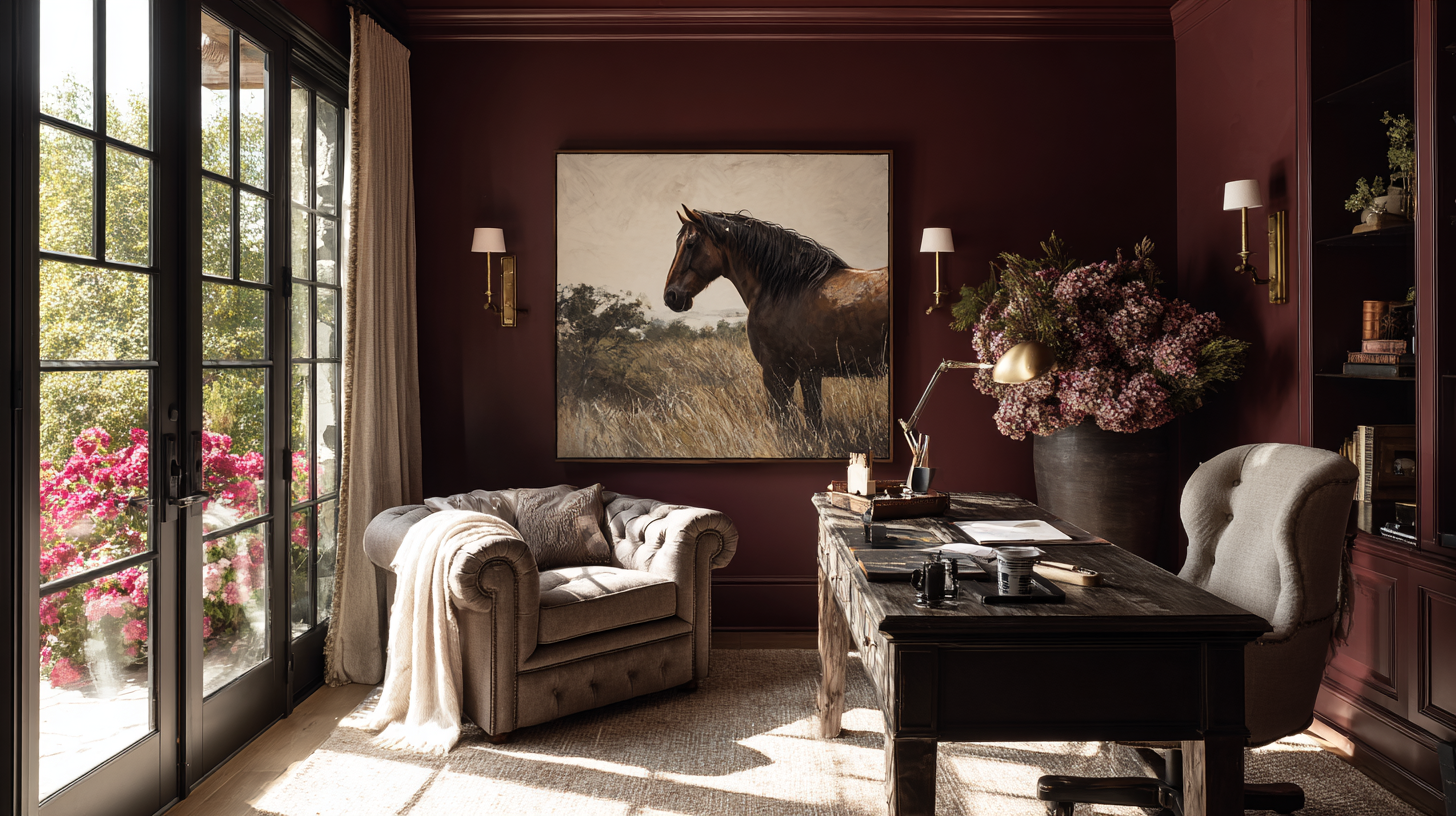
Studios & Offices
Outlaw Series — Cigarillo
Deep Brick Red
Bright Plum
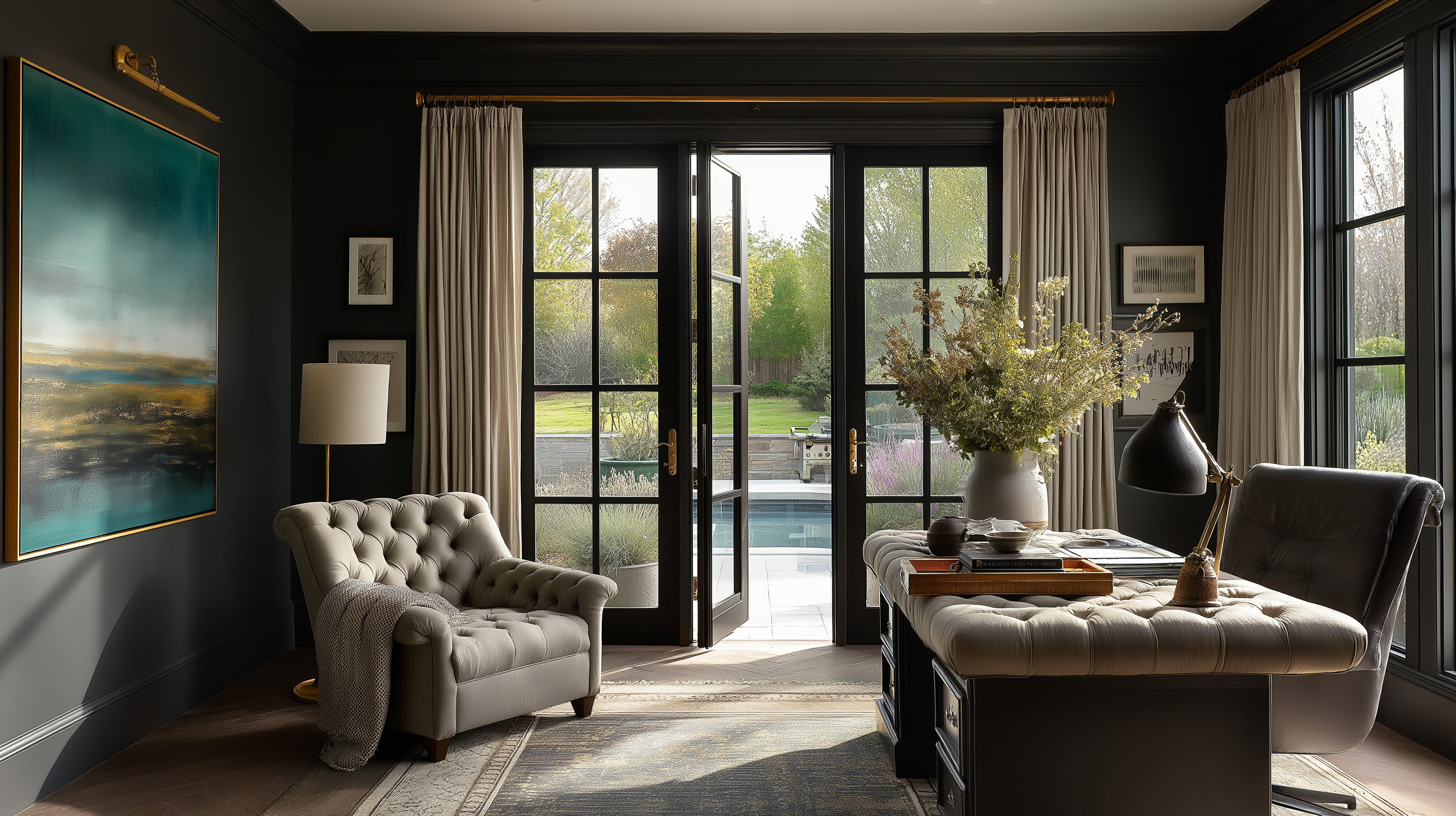
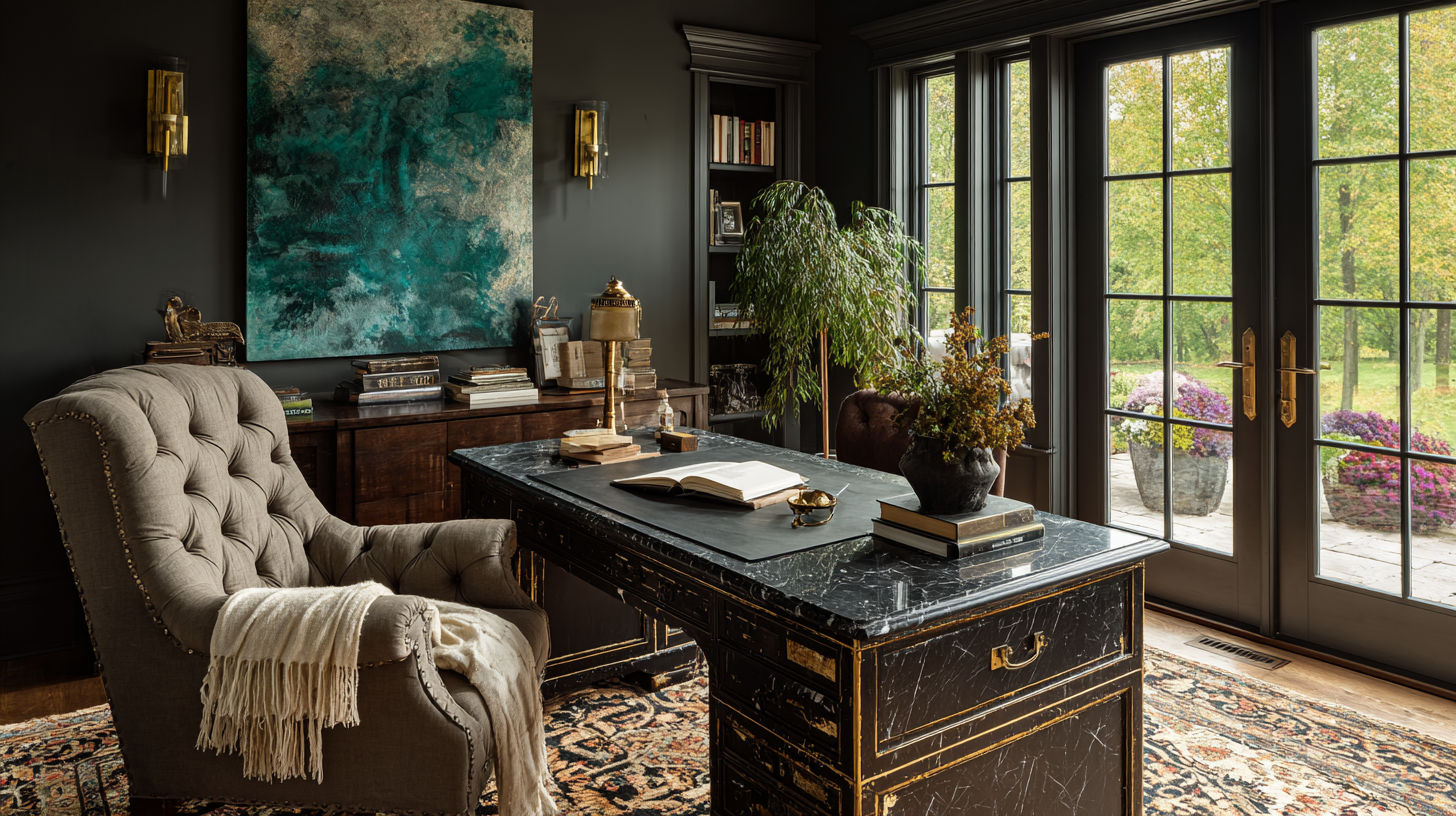
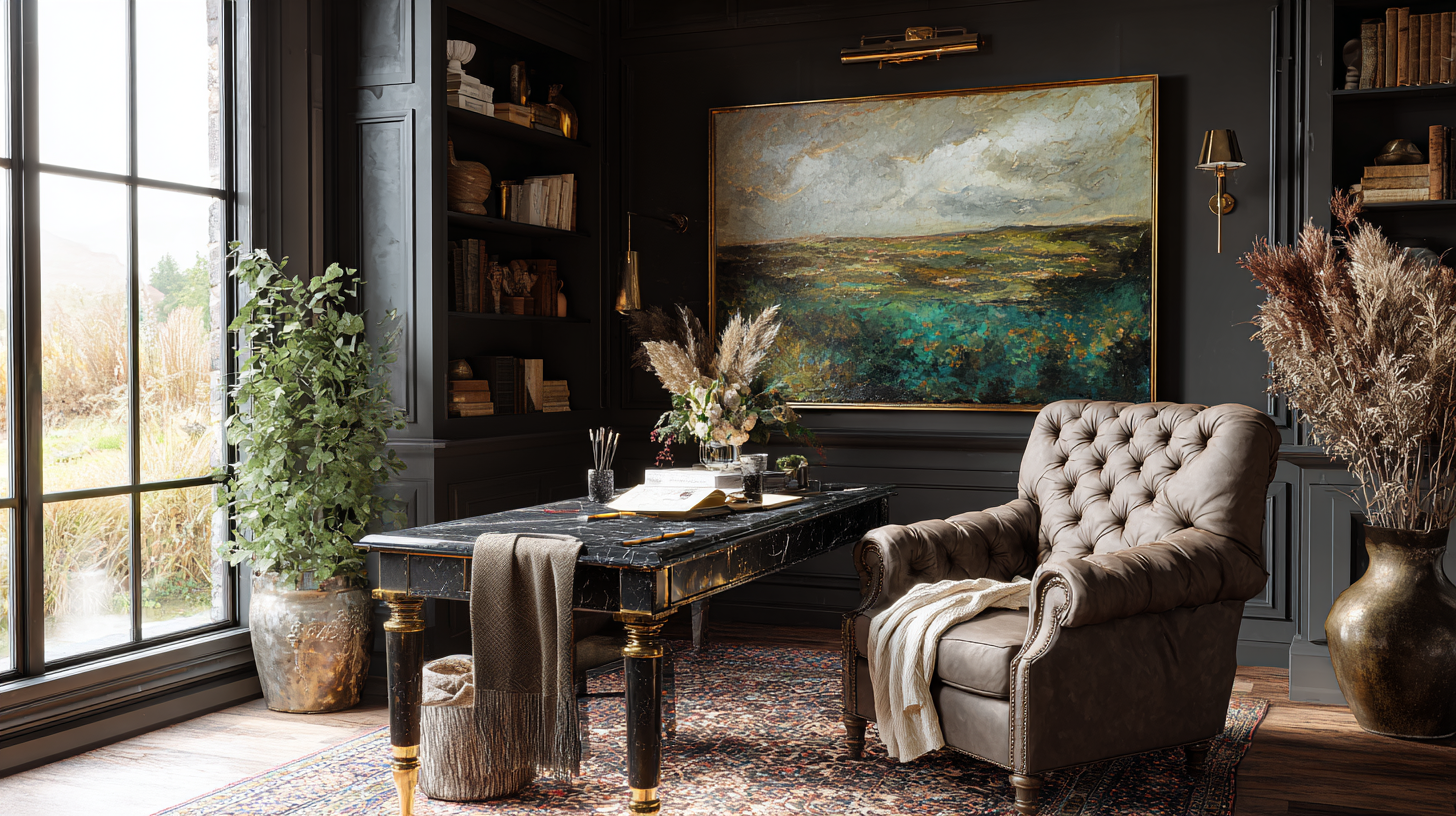
Charcoal Walls
Moody Study
Moody Office
Verandas & Sunrooms
Evening Sitting
Off the Bedroom
The Sunroom
Dining Rooms
Charcoal & Command
The Wildflower Suite
The Wildflower Suite
Spring Bedroom · Prairie Romance · Light & Air
The Vibe
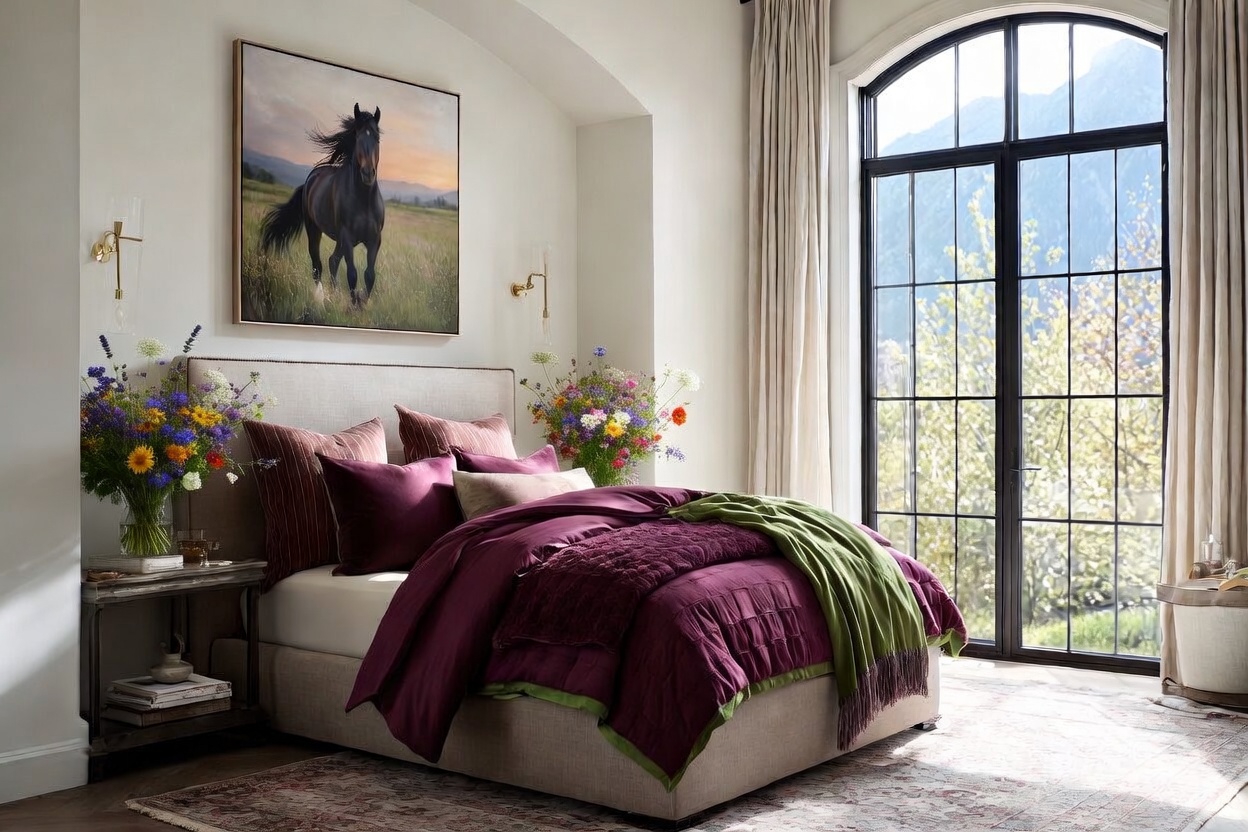
This room woke up before you did and has been enjoying the morning. Wildflowers on the wall — Libby standing in the field, unhurried, doing exactly what she wants — set the entire tone before a single piece of furniture was chosen. The room follows the art. It always does. Soft, warm, unguarded. The kind of space that makes you slow down without asking you to.
The Palette
Warm ivory — walls, ceiling, bedding
Prairie sage — textile accents, throw
Soft blush — secondary cushions
Natural linen — curtains, layering
Aged brass — minimal hardware, lamp
Mood & Feeling
Light rooms create a sense of expansion — the walls recede, the ceiling lifts, the morning feels possible. This palette does not compete with the view outside. It completes it. The wildflowers on the wall remind you where you are. The rest of the room reminds you to stay there a little longer.
The Appaloosa Room
The Appaloosa Room
High Contrast · Prairie Gothic · Bold & Still
The Vibe
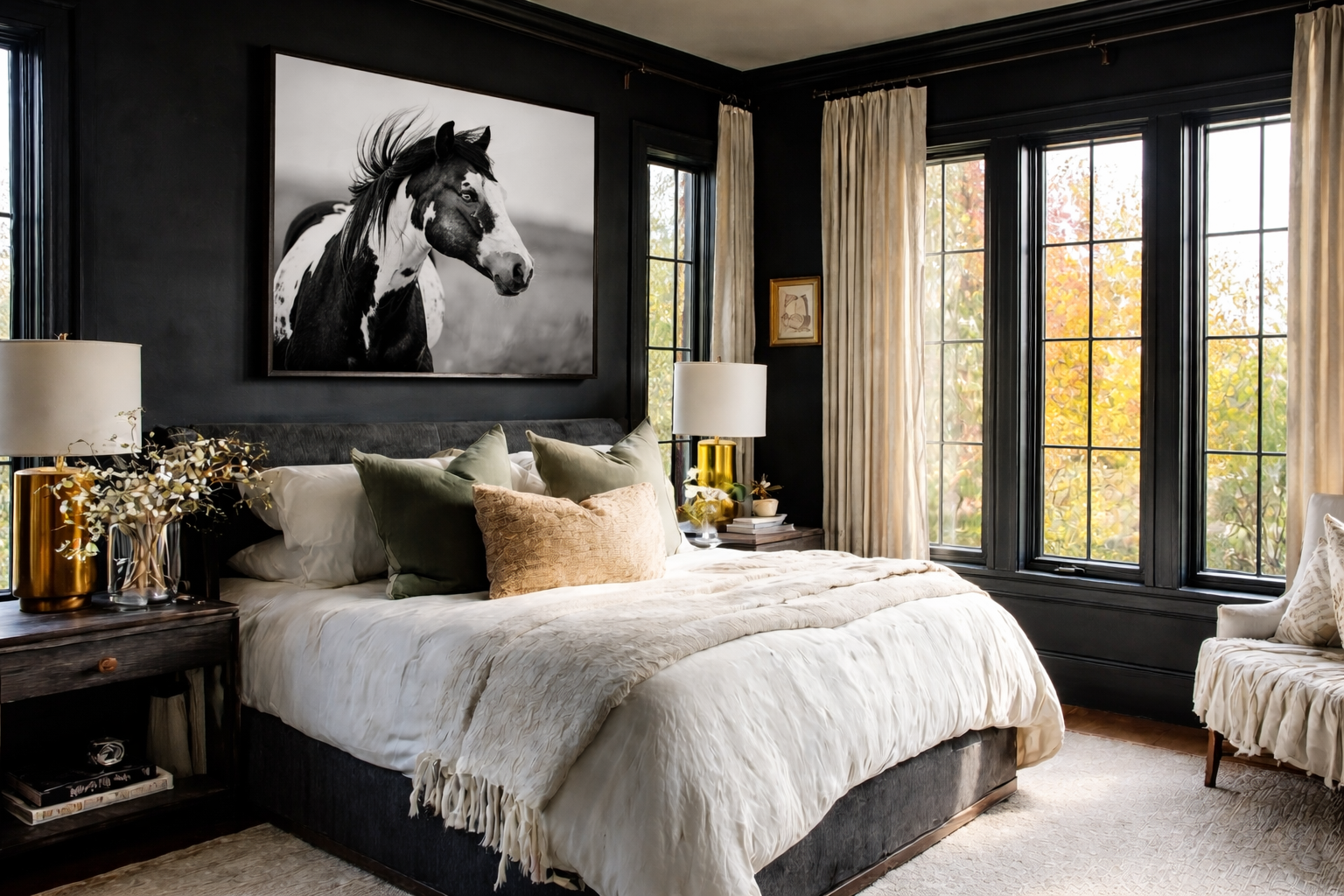
The art makes every decision in this room and it made them correctly. A black and white Appaloosa on the primary wall is not a decorative choice — it is an anchor. The room is organized around the fact of it. High contrast does something specific to a space: it sharpens your focus, it grounds you, it says this room knows what it is. Sleep comes easier in a room that has no ambiguity about itself.
The Palette
Crisp white — walls, primary bedding
Charcoal and black — art, accents, frame
Warm cream — secondary textiles
Matte black — hardware, lighting
Natural wood — warm contrast to the cool palette
Mood & Feeling
High contrast rooms are decisive rooms. They do not hedge. Black and white together create clarity — the brain reads the space immediately and settles. What looks bold in a paint chip reads as calm on the wall because there is nothing competing for attention. The Appaloosa is the conversation. Everything else is the room listening.
The Venice Room
The Venice Room
Old World Romance · Wanderer’s Rest · Deep & Warm
The Vibe
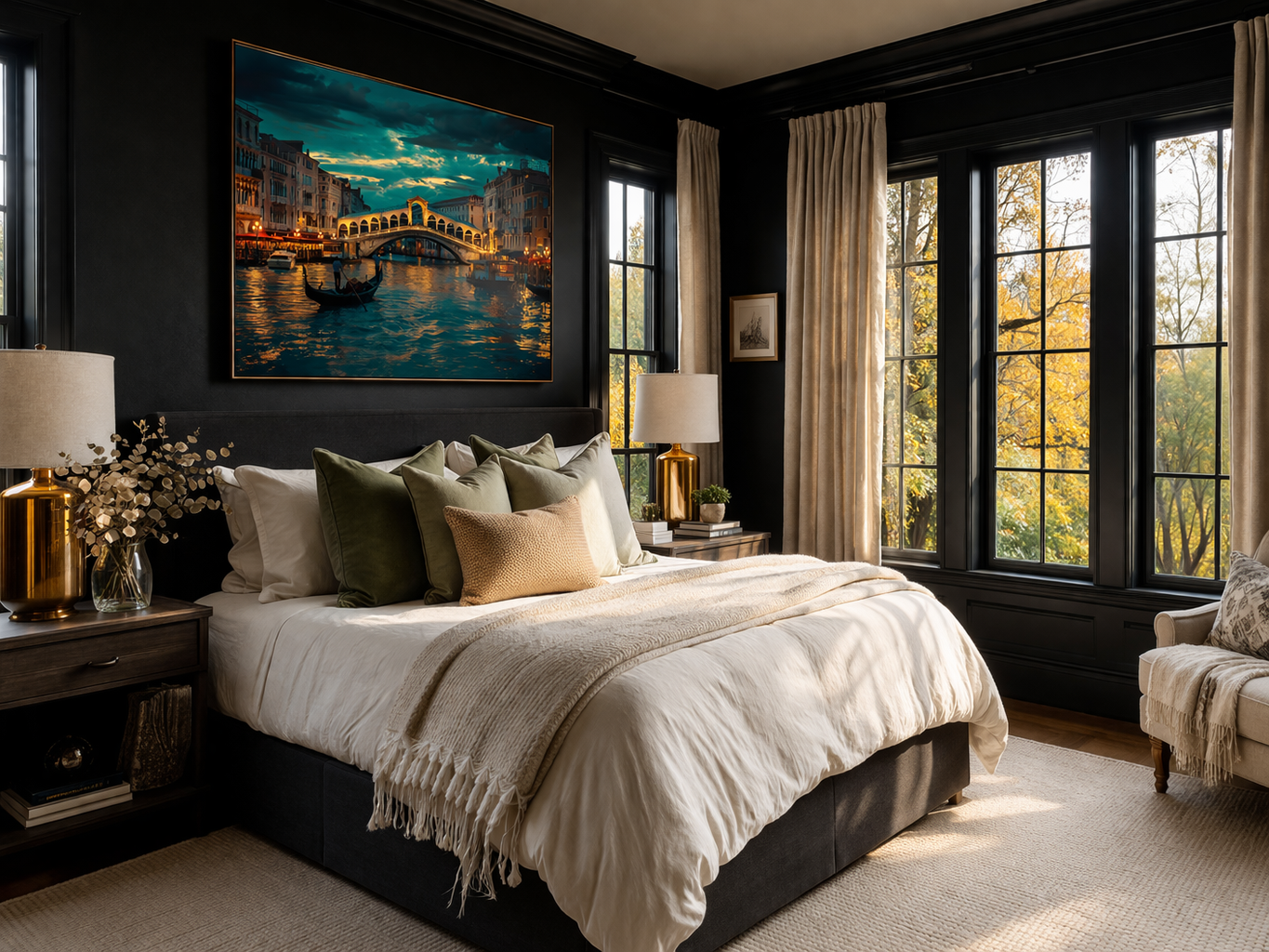
A Venice canal on the bedroom wall is a room that knows where it wants to be, even if it is not there. There is nothing wrong with that. The best rooms hold a sense of longing alongside a sense of belonging — they are both the place you are and the place you dream of. Deep, warm tones. Candlelight colors. A room for the kind of rest that feels earned.
The Palette
Deep teal and water blue — art tones pulled into textiles
Warm ivory — walls, ceiling
Aged gold — hardware, frame, lamp
Rich cream linen — bedding
Dark walnut — case goods
Mood & Feeling
Water imagery in a bedroom creates a sense of calm that is almost physiological. The eye reads depth and the body responds by slowing down. Pull one or two tones from the art into your textiles — not all of them, just enough to create a conversation between the wall and the bed. The rest of the room steps back and lets them talk.
The Bromeliad Room
The Bromeliad Room
Botanical Life · Vivid & Grounded · Waking Room
The Vibe
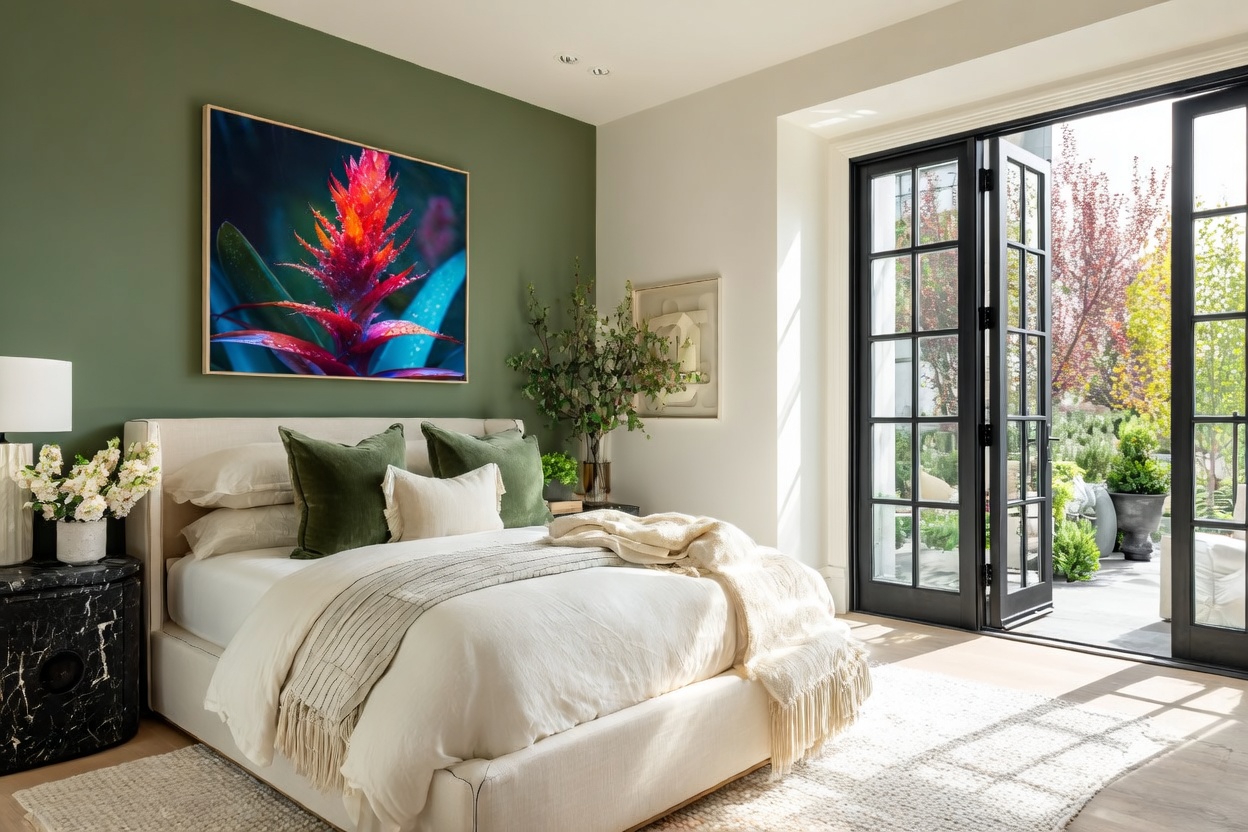
A bromeliad is a plant that does not apologize for its color. Neither should the room around it. This is a bedroom that believes life belongs inside — not just outside the window but on the wall, on the shelf, in the art. The botanical palette is vivid but not loud. It wakes you up without startling you, which is exactly what a good morning should do.
The Palette
Deep botanical green — art, accent textiles
Vivid coral and rust — art tones, pillow accents
Warm cream — walls, primary bedding
Natural rattan or light wood — furniture
Matte black — minimal hardware
Mood & Feeling
Green is the color the brain rests in most easily — it is what the eye is built to process. Botanical art brings nature into the room without requiring maintenance. The vivid coral tones in a bromeliad create energy without aggression. This is a room that says good morning and means it.
Cadet Song Botanical
Cadet Song Botanical Series
Soft Blue · Botanical Calm · Considered & Quiet
The Vibe
Cadet blue is the color of the sky on a morning that has decided to be decent to you. Paired with botanical art it becomes something specific — a room that is intelligent about its own gentleness. This is not a timid space. It is a considered one. There is a difference. The botanical series brings in organic form and the blue grounds it in a way that feels like exhaling.
The Palette
Cadet blue — walls or primary textile
Soft white — bedding, trim
Botanical green and ivory — art series tones
Aged brass — hardware, frame
Natural linen — curtains, layering
Mood & Feeling
Blue slows the heart rate. This is documented, not decorative. A cadet blue bedroom creates a physiological response toward calm — ideal for a room whose entire purpose is rest. The botanical art adds life without adding stimulation. The room is quiet. Intentionally so.
Navy Botanical
Navy Botanical
Deep Navy · Confident & Collected · Pattern with Purpose
The Vibe
Navy is the color of a room that has made its decisions and is comfortable with them. Botanical art alongside a zebra print pillow is a combination that works because both belong to the natural world — one just has more opinions about it. This room is confident without being loud. The pattern is controlled. The navy holds everything together the way a good navy always does.
The Palette
Deep navy — walls or primary bedding
Crisp white — bedding, trim, contrast
Black and white — zebra pattern pillow
Botanical green — art, secondary textile
Brass or gold — hardware, lamp
Mood & Feeling
Pattern works in a bedroom when it is singular and intentional. One pattern, supported by solid colors, reads as sophisticated. Two patterns fight each other and the room loses. The zebra print here is the single pattern. Everything else steps aside. That discipline is what makes the room work.
Cadet Song
Cadet Song
Blue-Grey · Timeless · The Room That Ages Well
The Vibe
Cadet grey-blue is the color that interior designers reach for when they want a room to look correct in twenty years. It is not trendy and it was not trendy ten years ago and it will not be trendy ten years from now — it will simply be right. This room has the particular confidence of something that was never trying to be fashionable. It was trying to be beautiful, which is a longer game and a better one.
The Palette
Cadet grey-blue — walls
Warm white — bedding, trim
Soft charcoal — accent, throw
Natural wood — warm counterpoint
Aged silver or brushed nickel — hardware
Mood & Feeling
Grey-blue creates a sense of depth in a room without making it feel smaller. It absorbs light in the evening and reflects it in the morning, which means the room behaves differently at different times of day. That is the mark of a color that understands space.
Navy Window Seat
Navy Window Seat
Deep Navy · The Reading Corner · Light Against Dark
The Vibe
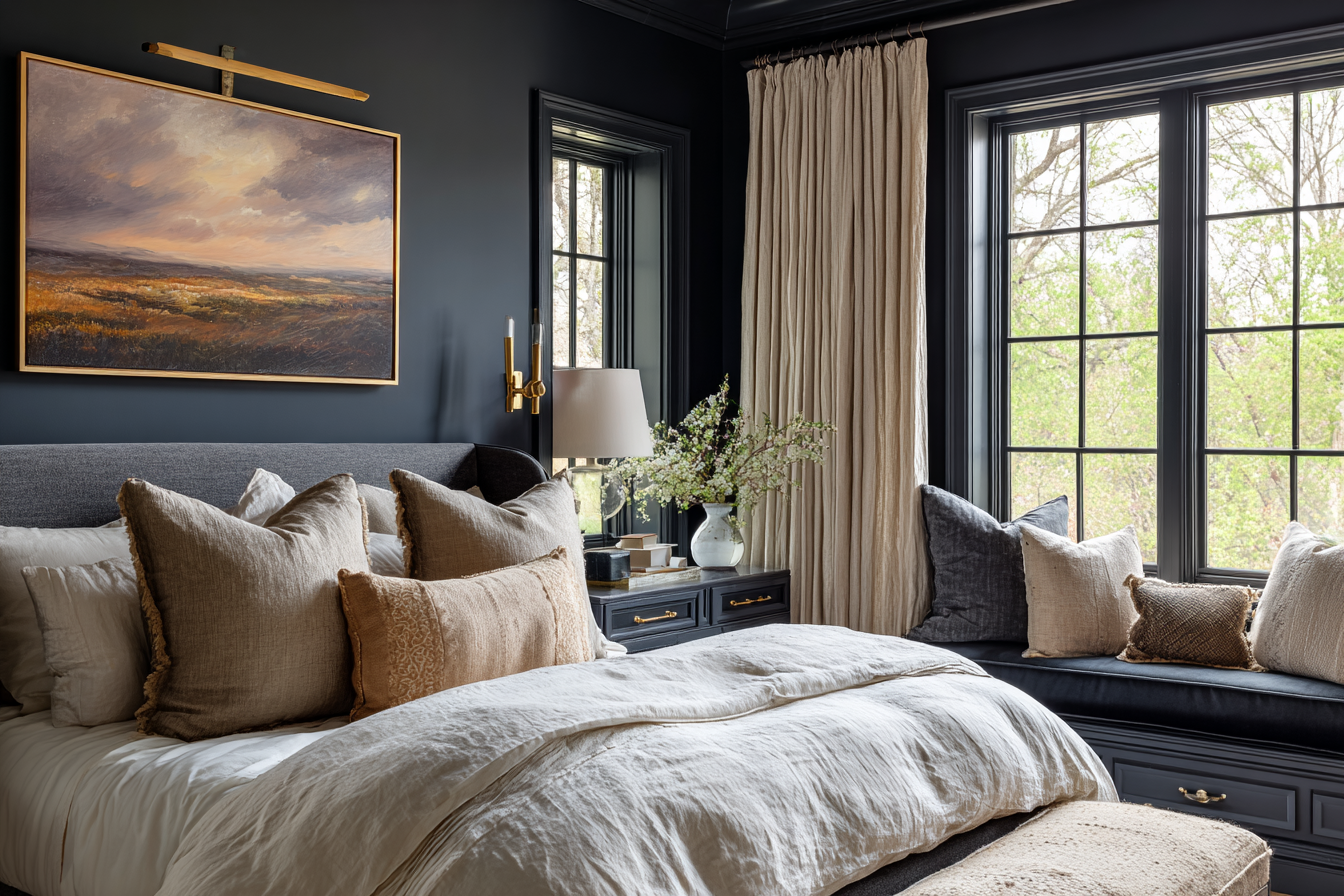
A window seat in a navy bedroom is one of the most specific pleasures a room can offer. The deep color of the wall makes the light from the window more vivid, more present, more noticed. You sit in the window seat because the room draws you there — the contrast between the darkness of the walls and the brightness of the glass creates a kind of gravitational pull toward the light. Every bedroom should have a destination inside it. This one has one.
The Palette
Deep navy — walls, the dominant statement
White trim — window frame, ceiling
Linen or cream — window seat cushion, bedding
Brass — hardware, reading lamp
Natural wood — floor, furniture
Mood & Feeling
Dark rooms feel intimate. They create a sense of enclosure that the brain reads as safe. This is why libraries are dark and why the best bedrooms often are too. The window seat breaks that enclosure with a point of light — and the contrast makes both the darkness and the light more powerful.
Deep Navy
Deep Navy
Full Commitment · Night Sky Interior · Cocoon
The Vibe
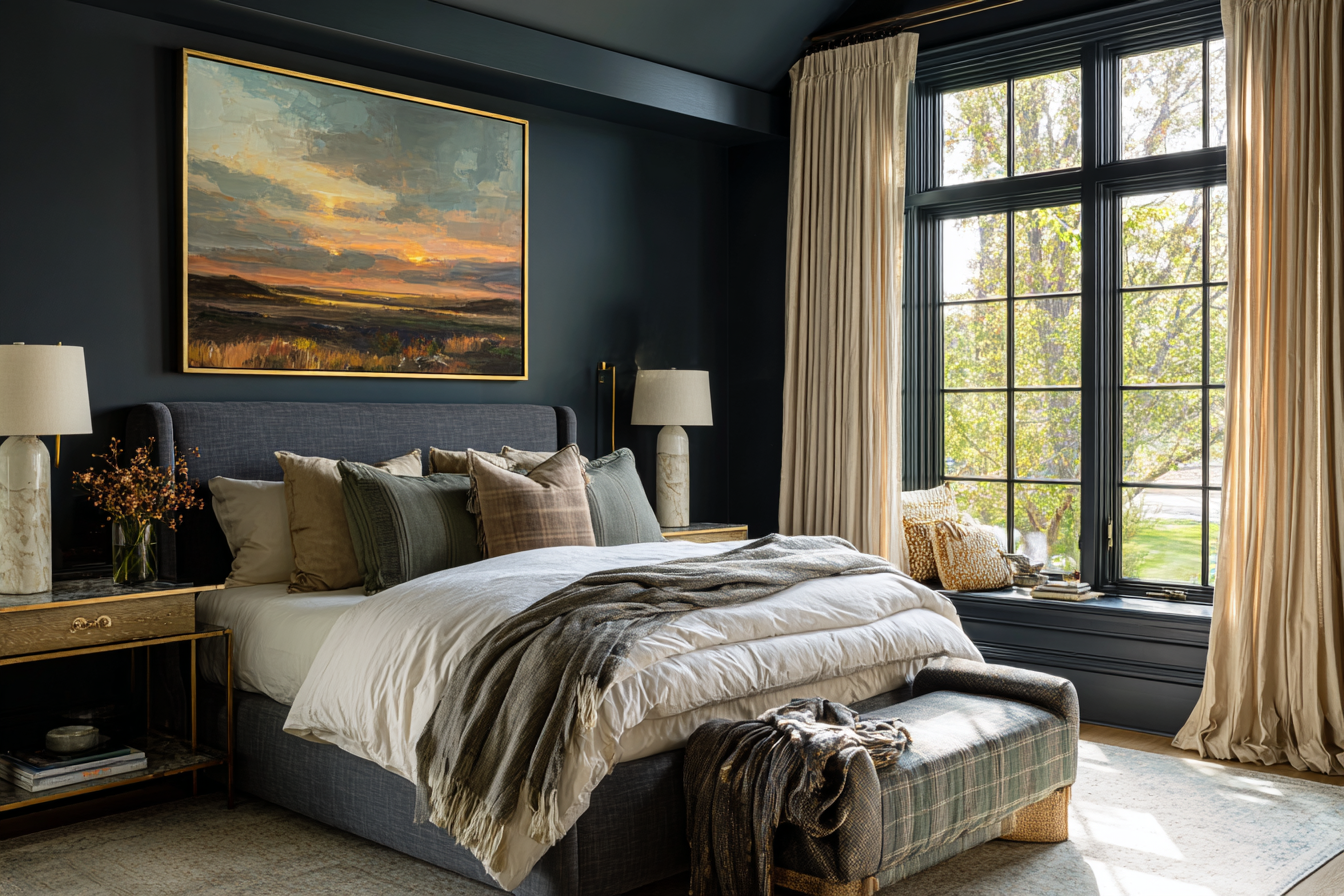
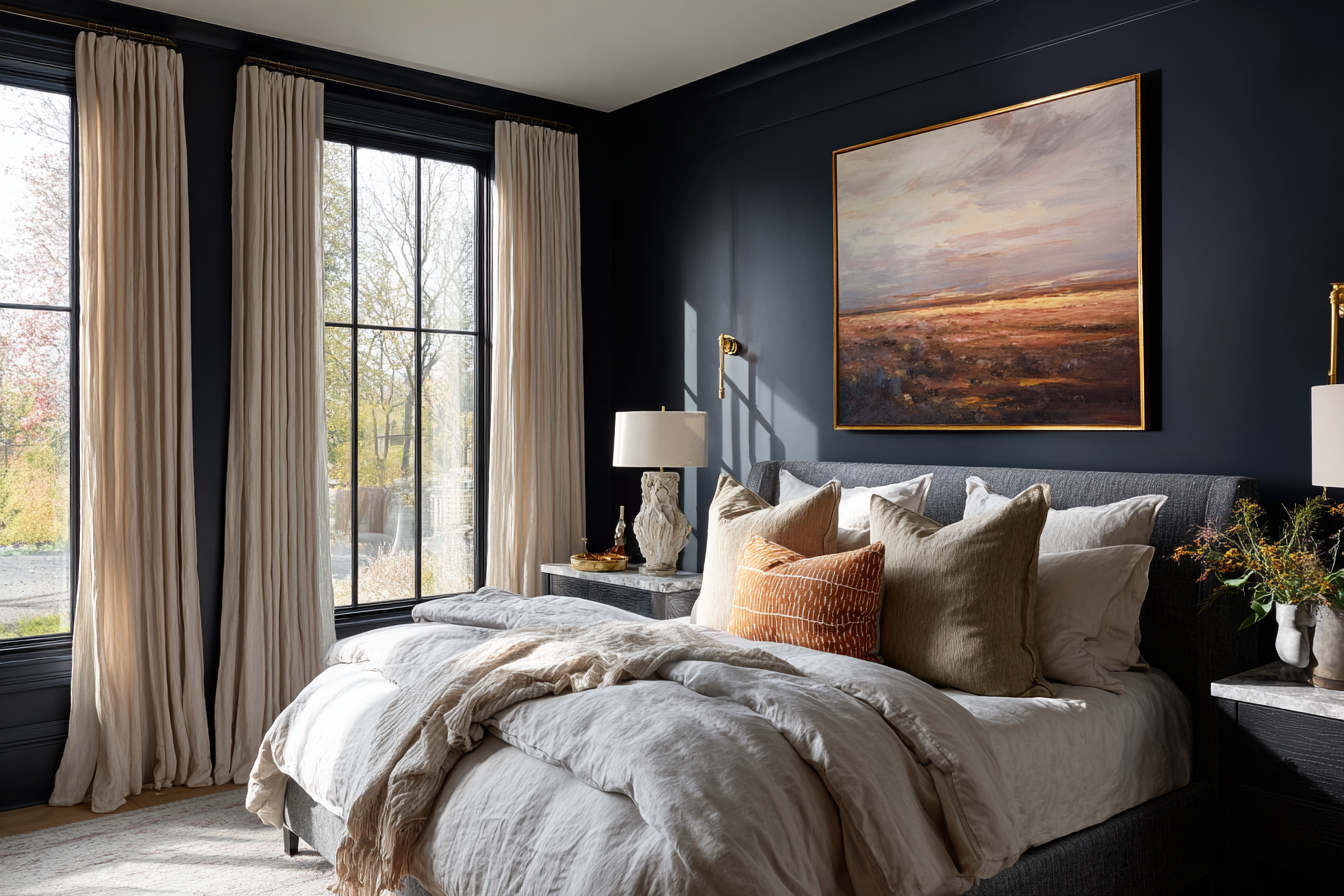
Full navy — ceiling, walls, the works — is a commitment most people are afraid to make. That fear is what keeps most bedrooms average. A deep navy room at night, lit only by warm lamp light, is one of the most beautiful things a bedroom can be. It wraps around you. It is the visual equivalent of a weighted blanket. Sleep happens in rooms like this because the room makes it easy.
The Palette
Deep navy — walls and ceiling, full commitment
Warm white — bedding only, maximum contrast
Gold and brass — hardware, lighting, frames
Cream or ivory — minimal secondary textiles
Dark wood — furniture, grounding
Mood & Feeling
The ceiling is the fifth wall and the most neglected one. Paint it the same dark color as the walls and the room becomes a cocoon rather than a box. The brain stops looking for where the room ends. It simply settles. That settling is what rest requires.
Deep Hunter Green
Deep Hunter Green
Forest Dark · Grounded & Rich · Lodge Sanctuary
The Vibe
Hunter green is the color of a room that takes itself seriously without taking itself too seriously. It is rich without being heavy, dark without being depressing, and warm in a way that navy sometimes is not. A hunter green bedroom has the feeling of a room inside a forest — contained, protected, deeply calm. The High Plains does not have forests, which may be exactly why this color works so well here. It brings what the land does not have.
The Palette
Deep hunter green — walls, the anchor
Cream and warm white — bedding, ceiling
Cognac leather — accent chair, bench
Aged brass — hardware, all fixtures
Dark walnut — furniture
Mood & Feeling
Green is the color the eye processes with the least effort. A hunter green room is restful in the most literal sense — the visual system relaxes into it. Paired with warm cream bedding the contrast is sufficient to prevent the room from feeling heavy. The brass pulls it out of darkness and into warmth.
Linen
Linen
Natural Tone · Unhurried · Prairie Morning
The Vibe
A linen-toned bedroom is a room that has decided not to compete with anything. Not with the view, not with the art, not with the person sleeping in it. It is the most generous color a bedroom can wear. Everything in the room shows up more clearly against it. The light, the texture of the bedding, the grain of the wood floor. Linen says: this room is for you. Everything else steps back.
The Palette
Warm linen — walls, the whole room
Natural linen — bedding, curtains, texture on texture
Warm white — trim, ceiling
Aged oak or light walnut — furniture
Unlacquered brass — hardware, ages beautifully
Mood & Feeling
Neutral rooms are not boring rooms. They are disciplined rooms. The discipline required to keep a linen palette correct — to resist adding something just because it is pretty — is the same discipline that makes the room beautiful over time. Neutrals reward patience. They also reward texture, which is where the interest lives in a room like this.
Cream & Clay
Cream & Clay
Earthy Warmth · High Plains Tone · Grounded Softness
The Vibe
Cream and clay together are the colors of the prairie itself — the pale sky, the brown earth, the particular warmth of a late afternoon before the light goes. This bedroom does not need art to have a landscape. The palette is already one. It is the calmest kind of room because it is the most honest about where it is. The High Plains lives in these tones. So does this room.
The Palette
Warm cream — walls, primary bedding
Clay and terracotta — accent, throw, pottery
Dusty sage — secondary textile
Raw linen — curtains
Matte iron or dark bronze — hardware
Mood & Feeling
Warm neutrals lower cortisol. This is not interior design mythology — it is the body responding to colors it recognizes as safe. Earth tones read as shelter. A bedroom built in cream and clay is a room the nervous system trusts. That trust is the foundation of rest.
Classic Navy
Classic Navy
Timeless · Clean & Sure · Never Wrong
The Vibe
Navy is never wrong. That is not a compliment — it is a fact worth understanding before you choose it. Navy does not have a bad season, a bad light, or a bad year. It is the most reliable color in the interior designer's vocabulary because it flatters everything it touches — wood, brass, white, linen, leather. This bedroom is not trying to be remarkable. It is trying to be exactly right. It is.
The Palette
Classic navy — walls
Bright white — trim, bedding, ceiling
Warm brass — hardware, lamp
Warm wood — floor, nightstand
One textile pattern — chosen carefully, used once
Mood & Feeling
Navy and white together create a sense of clarity. The mind reads the contrast as organized, which creates a low-level sense of control — the kind that is useful in a bedroom. You enter a room like this and something settles. Not because it is dramatic. Because it is right.
White Walls
White Walls
Maximum Light · Clean Canvas · The Art Leads
The Vibe
A white bedroom is a bedroom that has decided the art and the light are the room. The walls have nothing to say. That is not emptiness — it is restraint, and restraint is the hardest design skill to execute correctly. White walls amplify everything around them. The morning light is brighter. The art is stronger. The bedding reads more clearly. This room is whatever you bring to it, which means you had better bring something good.
The Palette
Pure or warm white — walls, ceiling
Layered white and cream — bedding, texture is everything here
One strong art piece — non-negotiable
Warm wood — the only warmth the room gets from architecture
Brass or aged metal — hardware, the punctuation
Mood & Feeling
White rooms feel largest in the morning and most intimate at night when the lamp comes on and the light pools. They are rooms of extremes — maximum light, maximum dark — and they require you to be deliberate about both. The art is not optional here. Without it the room is just walls. With the right piece it becomes something else entirely.
Deep Cadet Song
Deep Cadet Song
Saturated Blue-Grey · Moody & Still · Depth Without Dark
The Vibe
The deep version of cadet song is a room that has grown up. More saturated, more committed, more willing to hold the dark without apologizing for it. This is a bedroom for someone who has made their decisions and is comfortable with them — not a transitional room, not a placeholder. A room that means something. The color creates depth that the eye keeps reading, which is why the room never feels flat or finished. It keeps giving.
The Palette
Deep saturated blue-grey — walls
Warm white — ceiling, bedding contrast
Aged brass — hardware, essential warmth
Cognac leather or warm textile — chair or bench
Dark wood — grounds the blue
Mood & Feeling
Saturated colors create rooms that feel curated rather than decorated. The depth of the hue does the work that most people expect accessories to do. A room this color needs less — fewer objects, fewer textiles, less fuss. The color is already doing the heavy lifting. Let it.
Hunter Green & Dakota Sunset
Hunter Green & Dakota Sunset
Grounded · High Plains Pride · The Room That Knows Where It Is
The Vibe
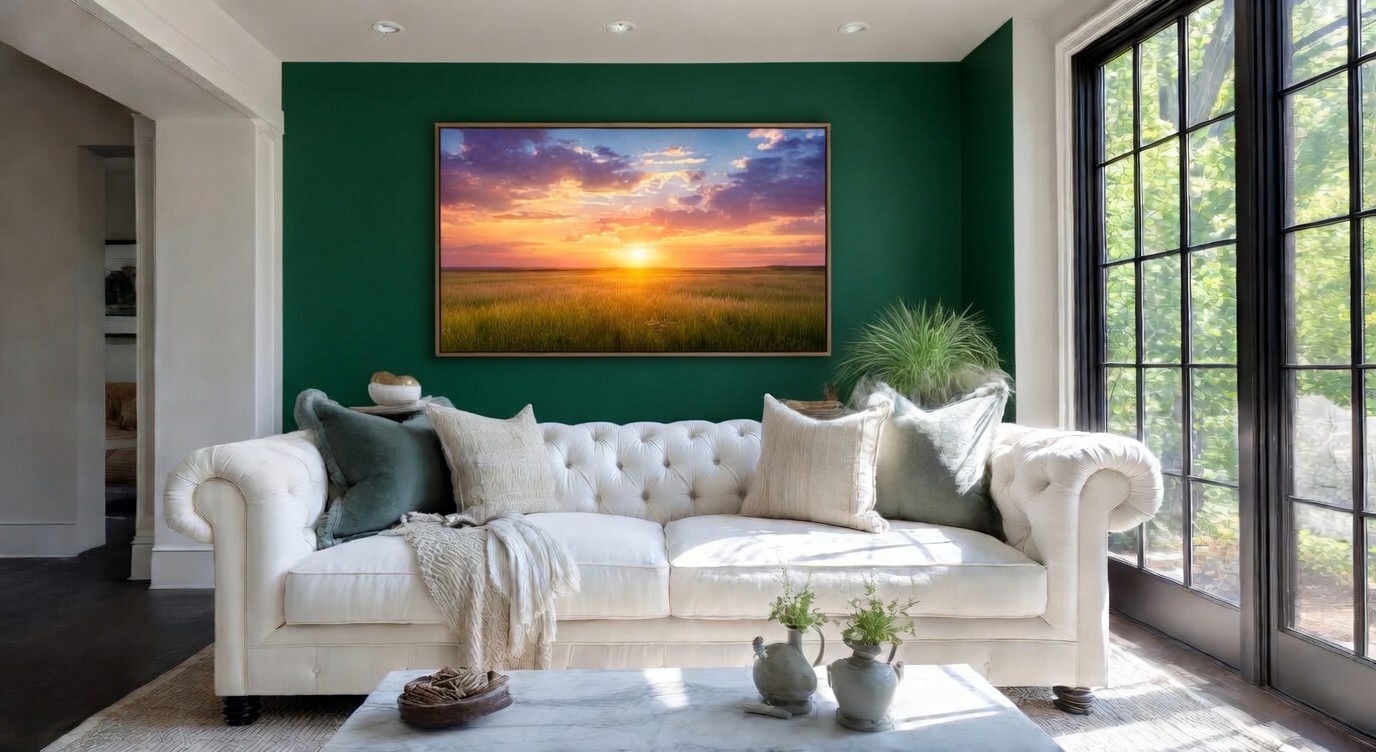
Hunter green walls and a Dakota sunset painting — this is a room that knows exactly where it is and has no desire to be anywhere else. The green grounds the space, pulls the eye down and inward, creates a sense of being held. The sunset on the wall opens it back up — light, distance, the enormous sky that defines life on the northern plains. These two elements are in conversation with each other. The room is the space between them.
The Palette
Deep hunter green — walls, the dominant statement
Warm cream — sofa, primary seating
Sunset amber and rust — pulled from the art into textiles
Dark walnut — tables, flooring
Aged brass — lamps, hardware, frames
Mood & Feeling
Green creates a sense of being enclosed in the best possible way — sheltered without being trapped. The sunset painting counterbalances that enclosure with the opposite sensation: openness, distance, the feeling of standing somewhere with a view. A room that offers both at once is a room people do not want to leave.
The Venice Room
The Venice Room
Old World Longing · Water & Light · Deliberate Escape
The Vibe
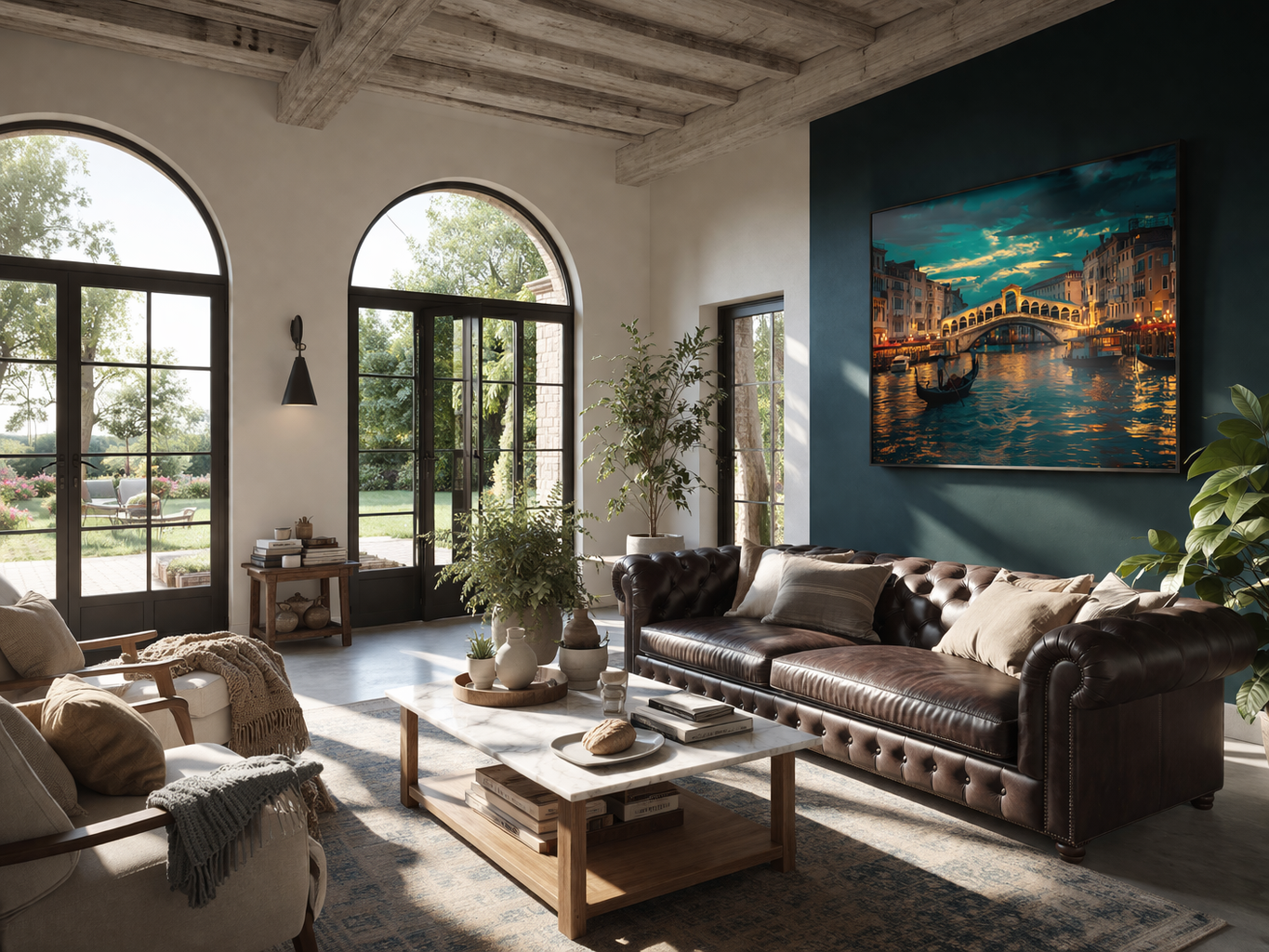
White walls and a Venice canal above the fireplace — this is a room that knows where it wants to be, even if it is not there. There is nothing wrong with that. A living room should offer something worth sitting in front of, something worth looking at while a conversation pauses. The Venice canal does that. The water, the light, the architecture of another world entirely. The room is here. The painting takes you somewhere else. Both are correct.
The Palette
Crisp white — walls, clean and open
Water blue and canal grey — tones pulled from the art
Warm cream — primary seating
Aged gold — frame, mirror, hardware
Warm wood — floor, furniture
Mood & Feeling
Water in art creates calm. The brain responds to the visual of still water the same way it responds to actual still water — the nervous system dials down slightly. A painting of Venice above a fireplace gives the room two sources of warmth: the fire and the light of the water. Both are ancient signals of safety. The room earns its ease.
Highlander — Curious Lucy
Highlander — Curious Lucy
Prairie Gothic · Warm Ochre · Character Rooms
The Vibe
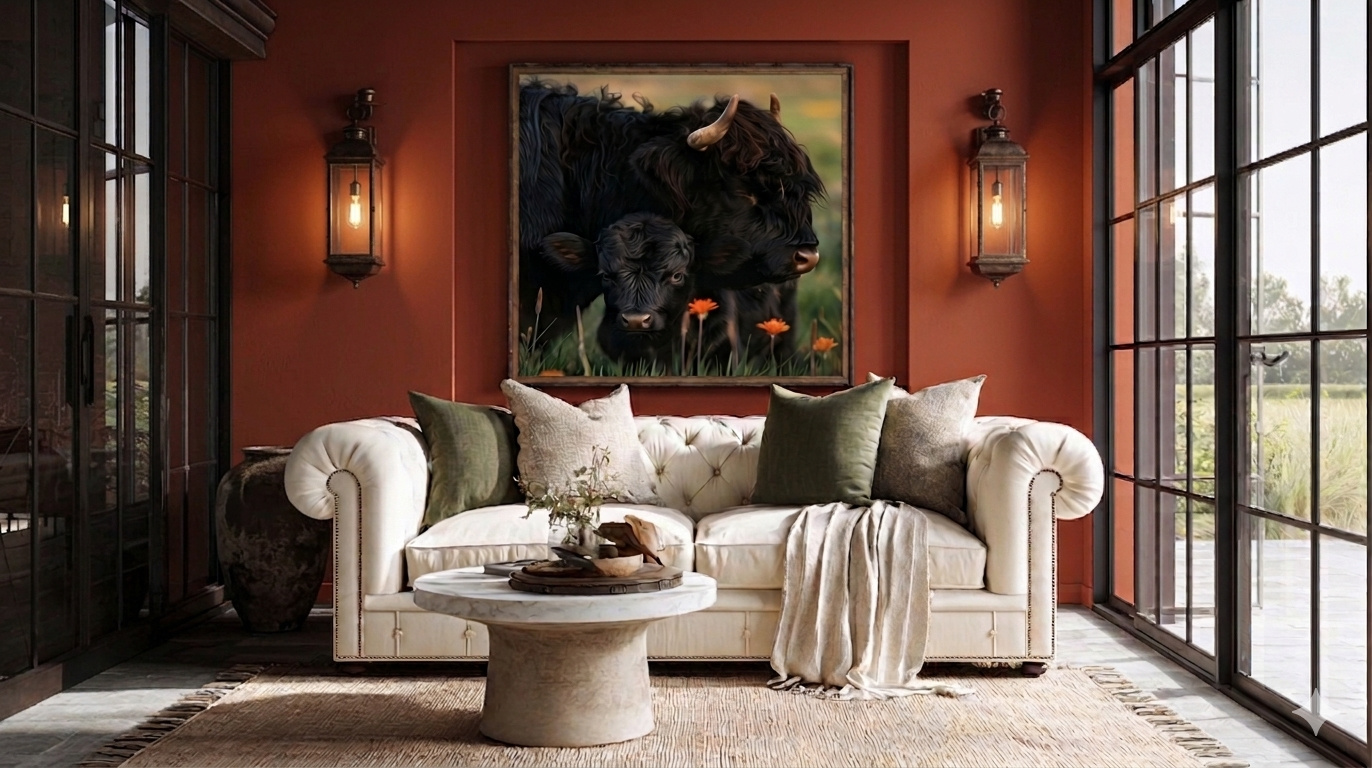
Lucy is curious. You can see it in the way she holds still just before she moves. A portrait of an animal with that kind of presence does something to a living room — it gives the room a personality that furniture alone never could. The warm ochre and rust tones surrounding her create a room that feels like autumn on the plains: rich, a little wild, and completely at ease with itself. This is not a room that is trying to impress you. It simply is what it is.
The Palette
Warm ochre and amber — walls or primary textile
Rust and terracotta — accent tones
Deep cream — sofa, balance
Dark walnut or ebony — furniture
Aged bronze — hardware, lamps
Mood & Feeling
Warm amber and ochre tones create a sense of late afternoon light even at nine in the morning. They are generous colors — they make everyone in the room look better, make the conversation feel easier, make the hour feel later and the company feel closer. A room in these tones invites you to stay. Most people do.
Ash & Baby
Ash & Baby
Tender & Strong · The Room That Holds Both
The Vibe
Ash is black and still and the calf beside her is new to everything. The painting holds both of those things at once — the stillness and the beginning — and the room has to be equal to that. Grounded enough for the darkness, soft enough for the calf. This is what the best living rooms do: they hold contradictions without resolving them. The tension between them is where the feeling lives.
The Palette
Warm greige or pale taupe — walls
Deep charcoal — accent, throw, textile
Soft cream — primary seating
Dark wood — tables and floor
Muted gold — hardware, frame
Mood & Feeling
The best living rooms feel both calm and alive. The painting of Ash and Baby does that work on the wall. The palette around it should not choose a side — not all dark, not all soft. The contrast in the art is the contrast in the room. Let the painting lead and the room will follow correctly.
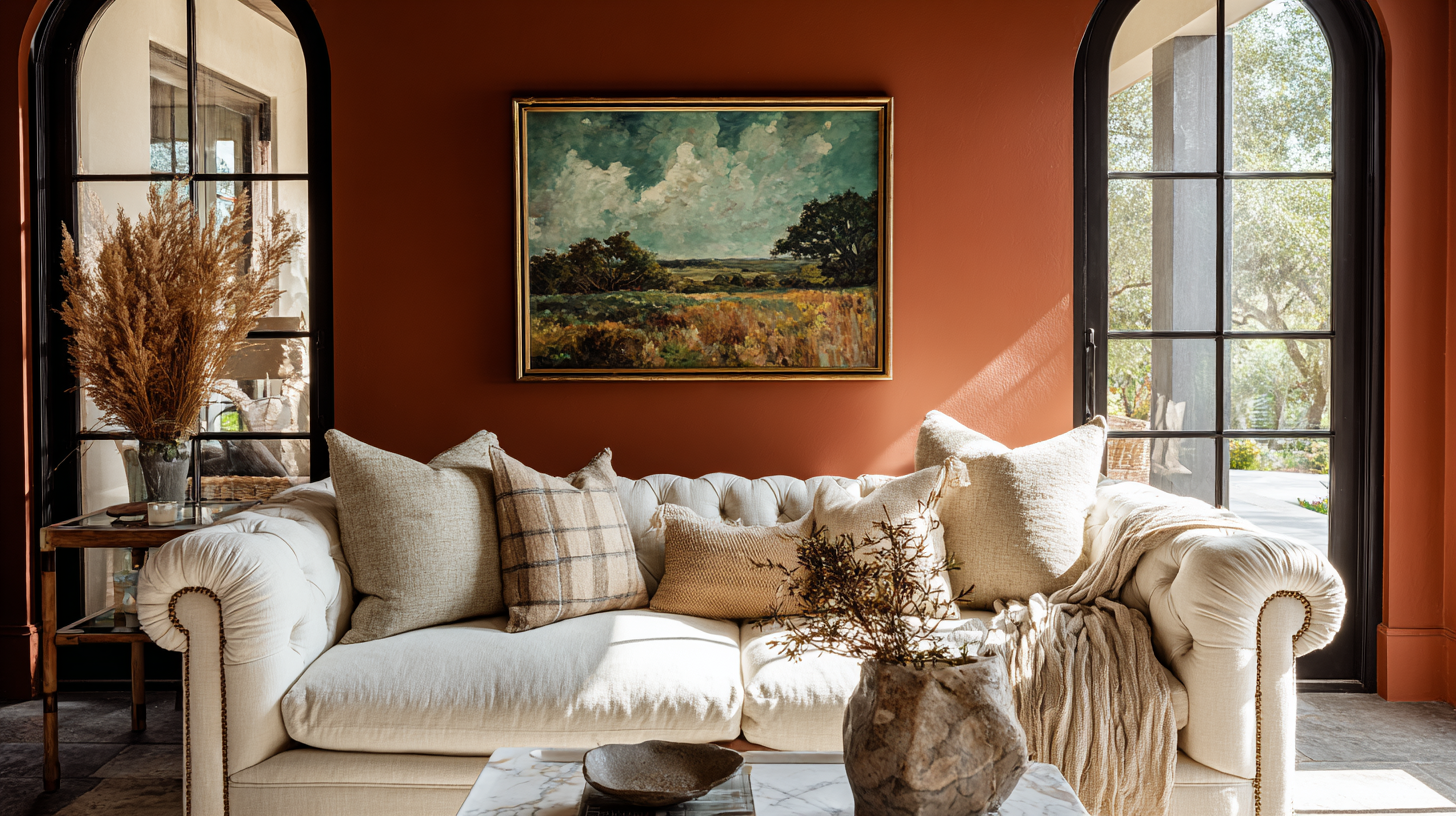
Terracotta is the color of clay pots left in the sun, of adobe walls in afternoon light, of earth that has been shaped by hand. In a living room it creates warmth that reads as structural — not added warmth, built-in warmth. The kind of room that feels the same temperature regardless of the season because the color itself radiates. Social rooms are better in warm colors. Conversation happens more easily. The tone does that work silently.
The Palette
Terracotta — walls, the full commitment
Cream and warm white — trim, balance
Rust and amber — accent textiles
Natural rattan and wicker — texture
Matte black — hardware, grounding
Mood & Feeling
Warm-toned rooms elevate mood and increase sociability. The research is consistent on this and so is the experience — people talk more, stay longer, and feel more comfortable in rooms that are warm in both temperature and tone. Terracotta delivers that without effort. It simply is warm. The room does the rest.
Purple Chesterfield
Purple Chesterfield
White Walls · One Bold Choice · The Piece That Leads
The Vibe
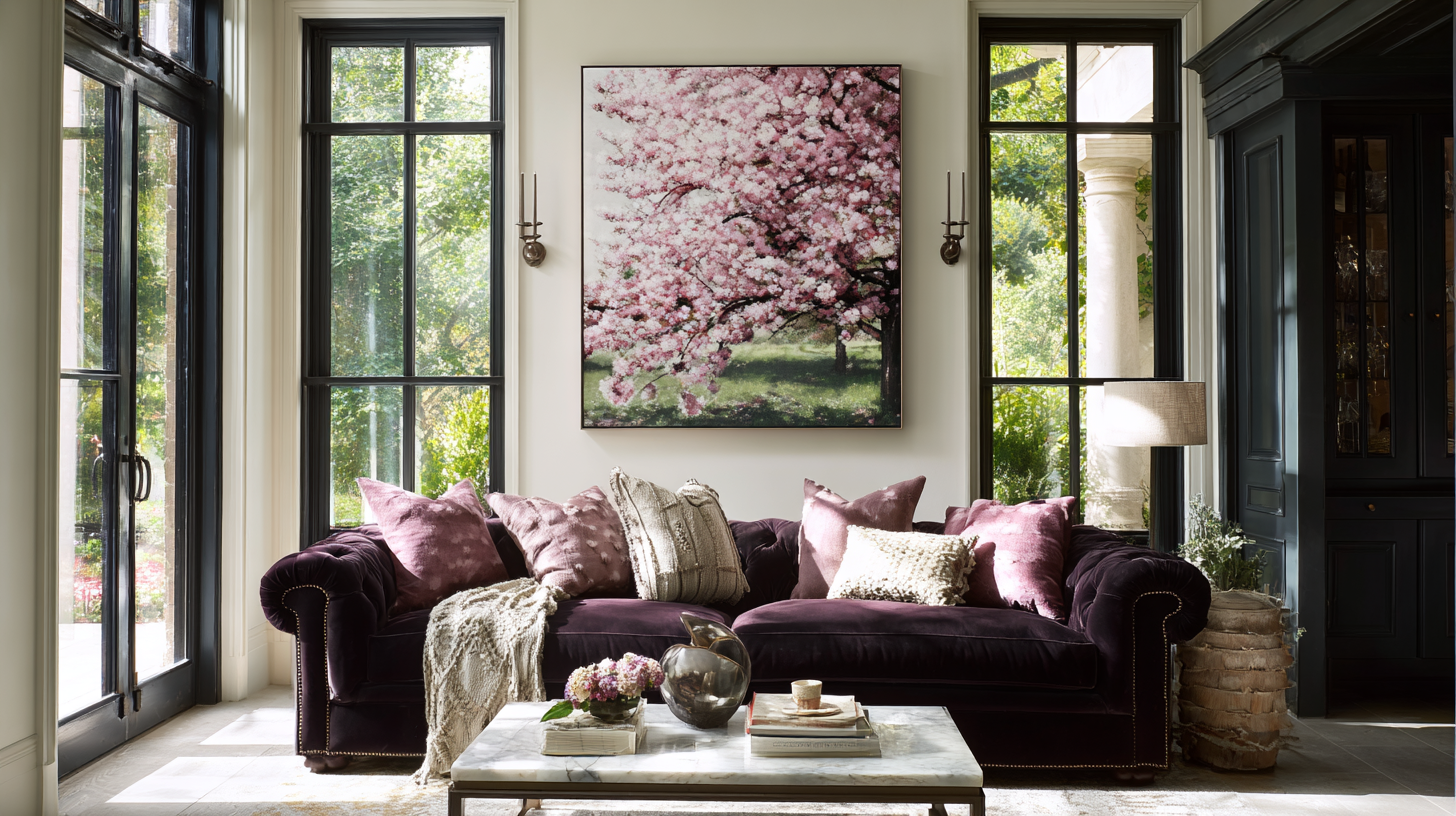
White walls exist to make one thing remarkable. In this room that thing is the purple chesterfield — tufted, substantial, completely sure of itself. The white around it does not compete. It amplifies. This is the design principle that most people get backwards: they put a bold sofa in a busy room where it disappears. Put it in a clean room and it becomes the entire conversation. The chesterfield earns that. The room gives it the stage.
The Palette
White — walls, ceiling, everything behind the sofa
Deep purple or plum — chesterfield, the star
Warm gold — hardware, lamp, frame
Natural wood — coffee table, floor
One or two neutral textiles — nothing that competes
Mood & Feeling
Purple is the color of considered confidence. It is not an easy choice and it is not supposed to be. A room built around a purple chesterfield announces immediately that the person who lives here makes deliberate decisions. That signal is its own kind of welcome. The room says: come in, this was all intentional.
White Walls
White Walls
Open & Bright · The Gallery Approach · Light First
The Vibe
A white living room is a room that has decided light is the design. It is the most forgiving and the most demanding choice simultaneously — forgiving because almost anything looks good against white, demanding because nothing can hide. The art has to be right. The furniture has to be right. The objects on the shelf have to earn their place. But when it works, a white living room at ten in the morning, with the sun coming through correctly, is one of the most beautiful rooms there is.
The Palette
White or warm white — walls, maximum light
Warm cream — primary seating
Strong art — the one non-negotiable
Natural wood — warmth against the white
Textural interest — linen, wool, woven — texture replaces color
Mood & Feeling
White rooms feel largest and most open. They create a sense of possibility — the room has not been filled yet, or it has been edited so well that it feels that way. Light moves around a white room differently than it moves around a colored one. It bounces. It accumulates in the corners. The room glows rather than absorbs. That glow is its own kind of warmth.
Hunter Green
Hunter Green
Rich & Enveloping · The Lodge Standard · Settled
The Vibe
Hunter green is one of the few colors that makes a living room feel simultaneously larger and more intimate. The depth of the green creates dimension on the walls — the eye reads it as having distance even in a small room. But the warmth of it pulls the furniture together, makes the seating arrangement feel closer, more gathered. It is the living room equivalent of a good fire. Not dramatic. Just right.
The Palette
Hunter green — walls, full and committed
Cream and warm white — primary seating, trim
Cognac leather — accent chair or ottoman
Dark walnut — tables, shelving
Aged brass — lamps, hardware, every metal surface
Mood & Feeling
Green is processed by the eye more easily than any other color. A hunter green room is restful in the truest sense — not sleepy, not flat, but genuinely easy to be in for a long time. It does not create fatigue. It creates the opposite. An hour in a hunter green room feels like the right kind of hour.
Bright Teal & White Marble
Bright Teal & White Marble
Bold Color · Working Kitchen · Joyful & Precise
The Vibe
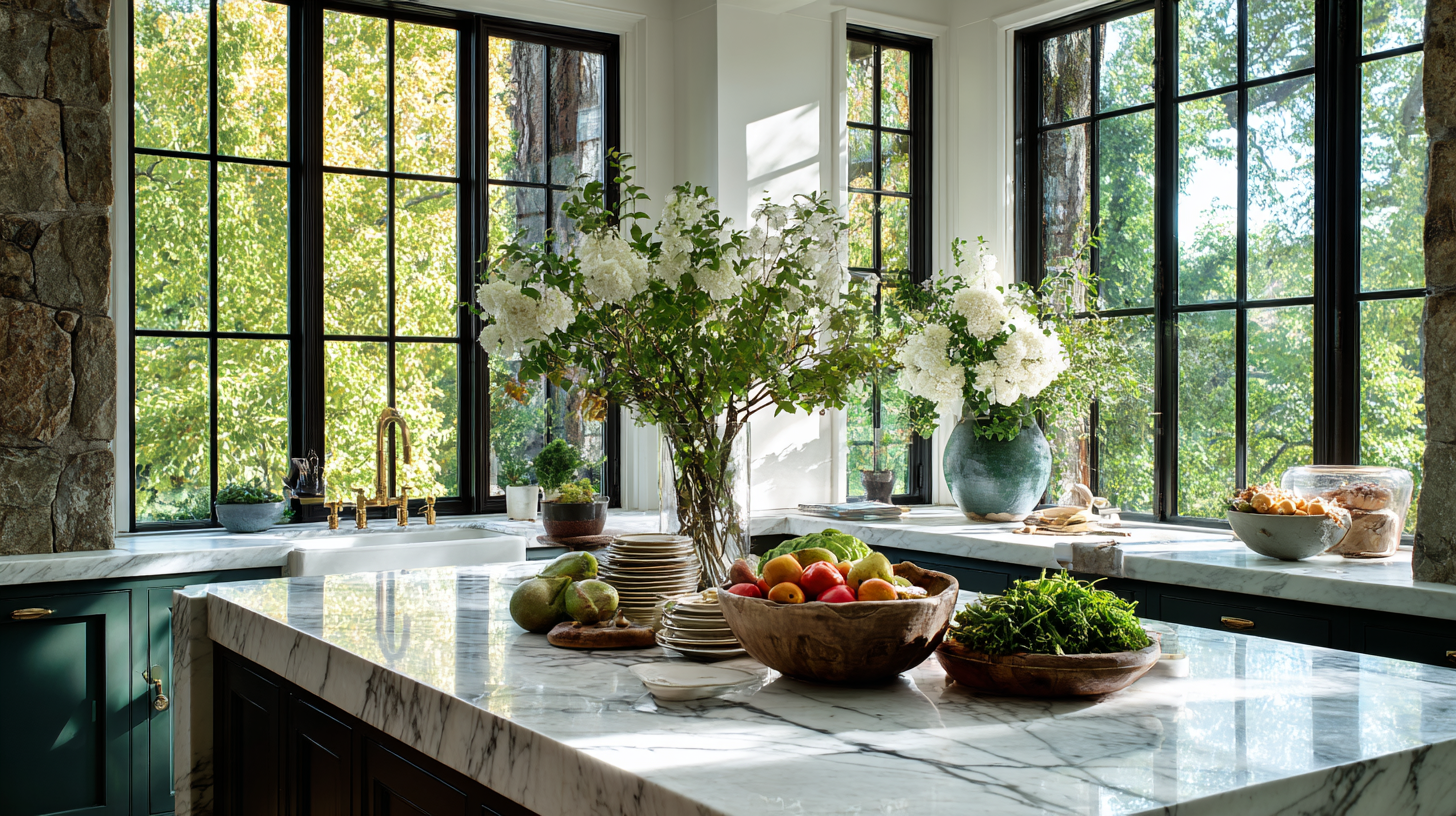
Bright teal cabinets are not a timid choice. They are the choice of someone who has decided the kitchen should be a room worth walking into, not just a room to walk through. Against white marble they become something specific — vivid but controlled, bold but clean. This kitchen says something the moment you see it. What it says is: the person who cooks here enjoys it. That energy is in the room before anything is prepared.
The Palette
Bright teal — lower cabinets, the statement
White or cream — upper cabinets, balance
White marble — counters, cool and elegant
Brass or gold — hardware, warm counterpoint
White subway or tile — backsplash, clean frame
Mood & Feeling
Teal is the color of the ocean at its clearest and the sky at its most interesting. In a kitchen it creates energy without creating stress — it motivates without overwhelming. People cook better in kitchens they enjoy being in. Color is part of that enjoyment. This kitchen knows it.
Black Cabinets & White Island
Black Cabinets & White Island
Maximum Contrast · Serious Kitchen · No Apology
The Vibe
Black cabinets mean business. They say: this kitchen is not decorative. It works. The white island creates the contrast that keeps the room from feeling heavy and gives it the visual center that every great kitchen needs — the place where everything happens, where the conversation gathers, where the prep begins. This is a kitchen for someone who knows what they are doing at a stove. The room matches that.
The Palette
Matte black — perimeter cabinets
White or bright white — island, maximum contrast
Dark counters — perimeter, continuous with cabinets
Light counter — island, the contrast point
Brass or unlacquered brass — hardware, the warmth
Mood & Feeling
High contrast kitchens create focus. The eye knows immediately where to look — the island is the center of gravity and everything else is organized around it. That visual clarity translates into functional clarity. A kitchen that is easy to read is a kitchen that is easy to work in. The black and white palette does that structural work for you before you open a drawer.
Parisian Cityscape
Parisian Cityscape
Romantic · The Soaking Tub Room · Deliberate Escape
The Vibe
A Parisian cityscape above a soaking tub is a room that understands what the bathroom is actually for. Not efficiency. Restoration. If you are going to spend twenty minutes doing nothing you should at least have something worth looking at while you do it. Paris above the tub gives you that — the rooftops, the grey-gold light, the particular quality of a city that has been beautiful for a very long time and knows it. The room does not need to be grand. The painting makes it so.
The Palette
Soft grey and warm ivory — walls, tiles
City grey-blue — tones pulled from the art
Aged gold — fixtures, frame, hardware
White soaking tub — freestanding, the centerpiece
Warm marble — floor, counter
Mood & Feeling
The bathroom is the one room in the house where you are permitted to do absolutely nothing without justification. The design should honor that. Art above the tub is not indulgent — it is appropriate. Warm tones in the tile and fixture create the sensation of warmth even before the water runs. The room should feel like it is already waiting for you.
Field of Flowers
Field of Flowers
Botanical Softness · Spring Bathroom · Light & Fresh
The Vibe
A field of flowers in the bathroom is morning light made permanent. The art brings the outside in and the bathroom becomes the first and last nature you encounter in a day — which is exactly what it should be. Soft, fresh, alive. A room that makes the morning feel like a beginning rather than an obligation. The floral art is not precious here. It is purposeful.
The Palette
Warm white — walls, tile
Soft botanical tones — blush, sage, ivory — pulled from the art
Natural stone — floor, gentle texture
Brushed nickel or warm brass — fixtures
Fresh white fixtures — sink, tub
Mood & Feeling
Floral art in a bathroom creates a sense of freshness that has nothing to do with cleaning products. It is visual freshness — the brain reads the flowers and responds accordingly. Mornings are easier in rooms that feel alive. This room earns that feeling through its art and asks nothing complicated of the palette around it.
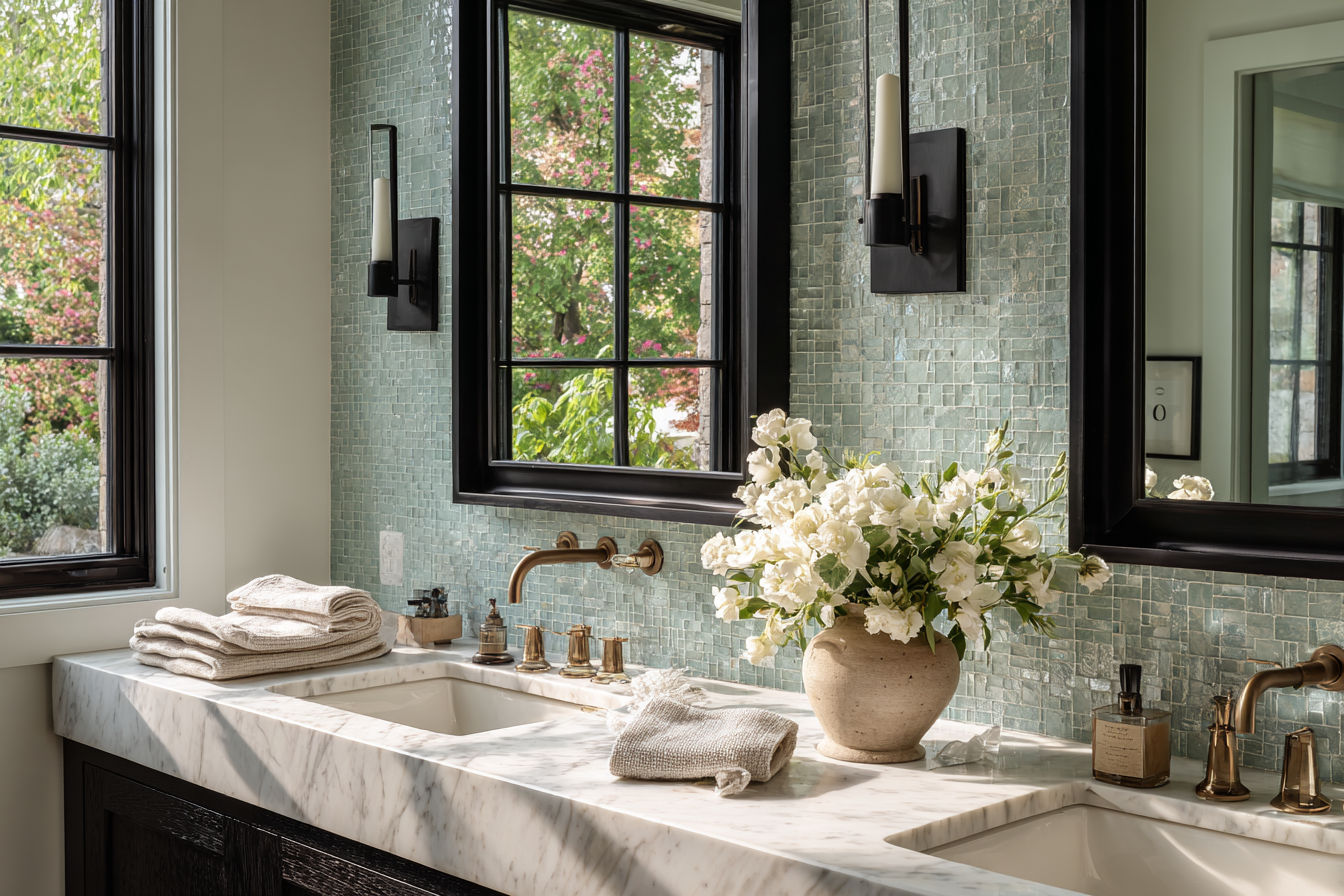
Sea Glass Vanity
Sea Glass Vanity
Water Tones · Morning Light · Worth Standing Still For
The Vibe
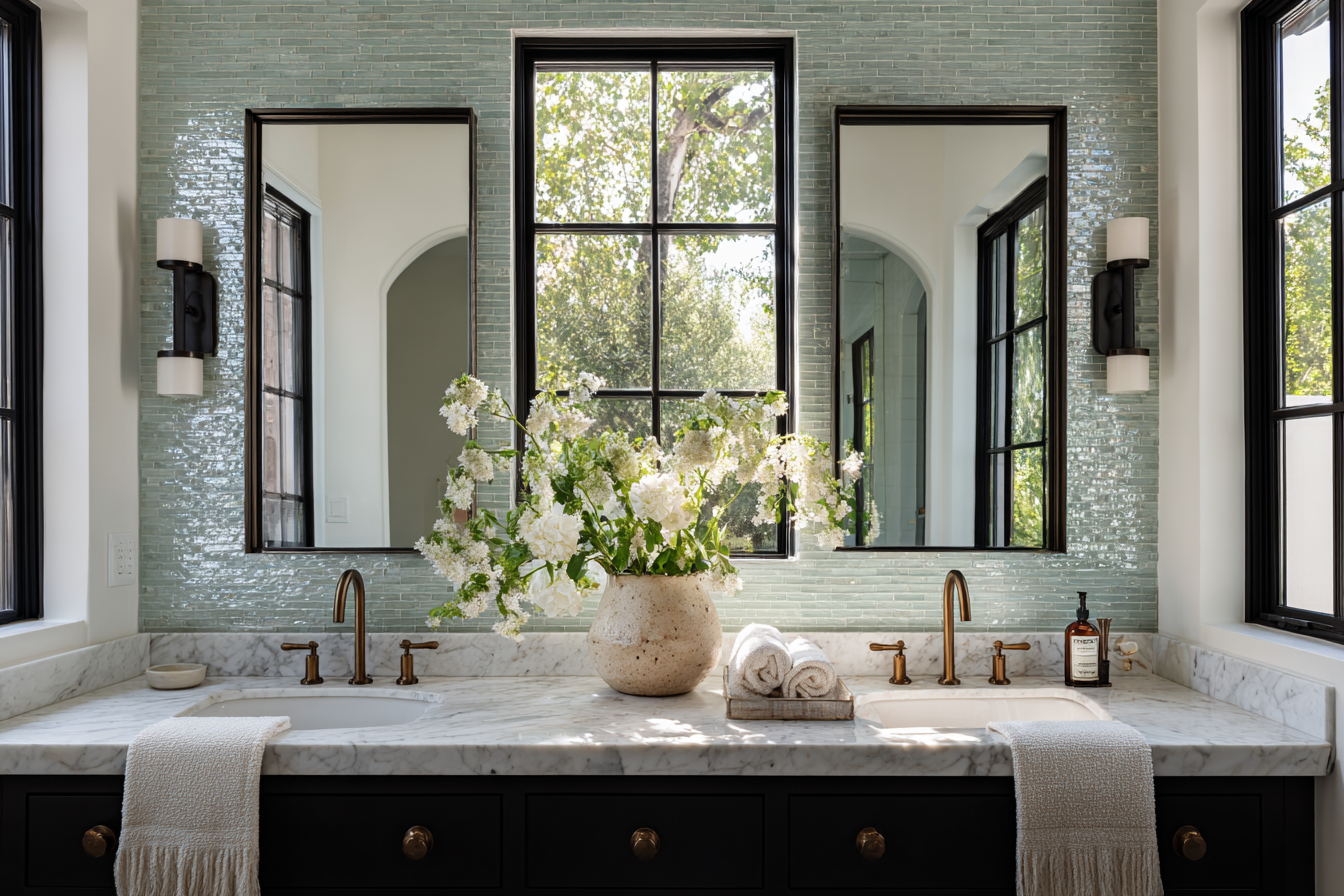
Sea glass tile turns the morning light into something worth standing still for. The color — that particular green-blue of glass worn smooth by water — catches light differently at different times of day. In the morning it is cool and clean. In the evening with warm light it warms slightly and the room shifts. A bathroom that changes with the light is a bathroom you notice. You should notice it. It is the room you begin and end every day in.
The Palette
Sea glass green-blue — tile, the primary statement
Warm white — fixtures, ceiling, balance
Natural stone or light marble — counter, floor
Brushed brass — fixtures, hardware
White grout — keeps the tile clean and bright
Mood & Feeling
Water tones in a bathroom create a sense of cleanliness that precedes the act of washing. The brain responds to the color the way it responds to the ocean — with a kind of settling. Sea glass tile is that response made permanent in a room. The feeling it creates is not decorative. It is functional.
Sea Glass Suite
Sea Glass Suite
Full Sea Glass · Immersive · The Whole Room in One Color
The Vibe
When the sea glass goes full suite — tile on the floor, tile on the walls, the color surrounding you rather than accenting you — the room becomes a different experience entirely. Immersive. The color is not something you look at. It is something you are inside. That experience, done correctly with warm fixtures and natural stone to break the repetition, is one of the most calming rooms a bathroom can be.
The Palette
Sea glass — floor and wall tile, continuous
Warm white fixtures — sink, tub, relief
Natural stone counter — breaks the tile repetition
Unlacquered brass — fixtures, ages warm
White towels only — the textiles stay out of the way
Mood & Feeling
Immersive color bathrooms require confidence in the commitment and restraint in the details. Everything that is not tile should be simple, warm, and neutral — fixtures, stone, towels. The color is the entire room. The accessories are not. That distinction, maintained consistently, is what makes the room succeed rather than overwhelm.
Sea Glass Walk-In
Sea Glass Walk-In
The Shower as Experience · Water Meets Water · Restorative
The Vibe
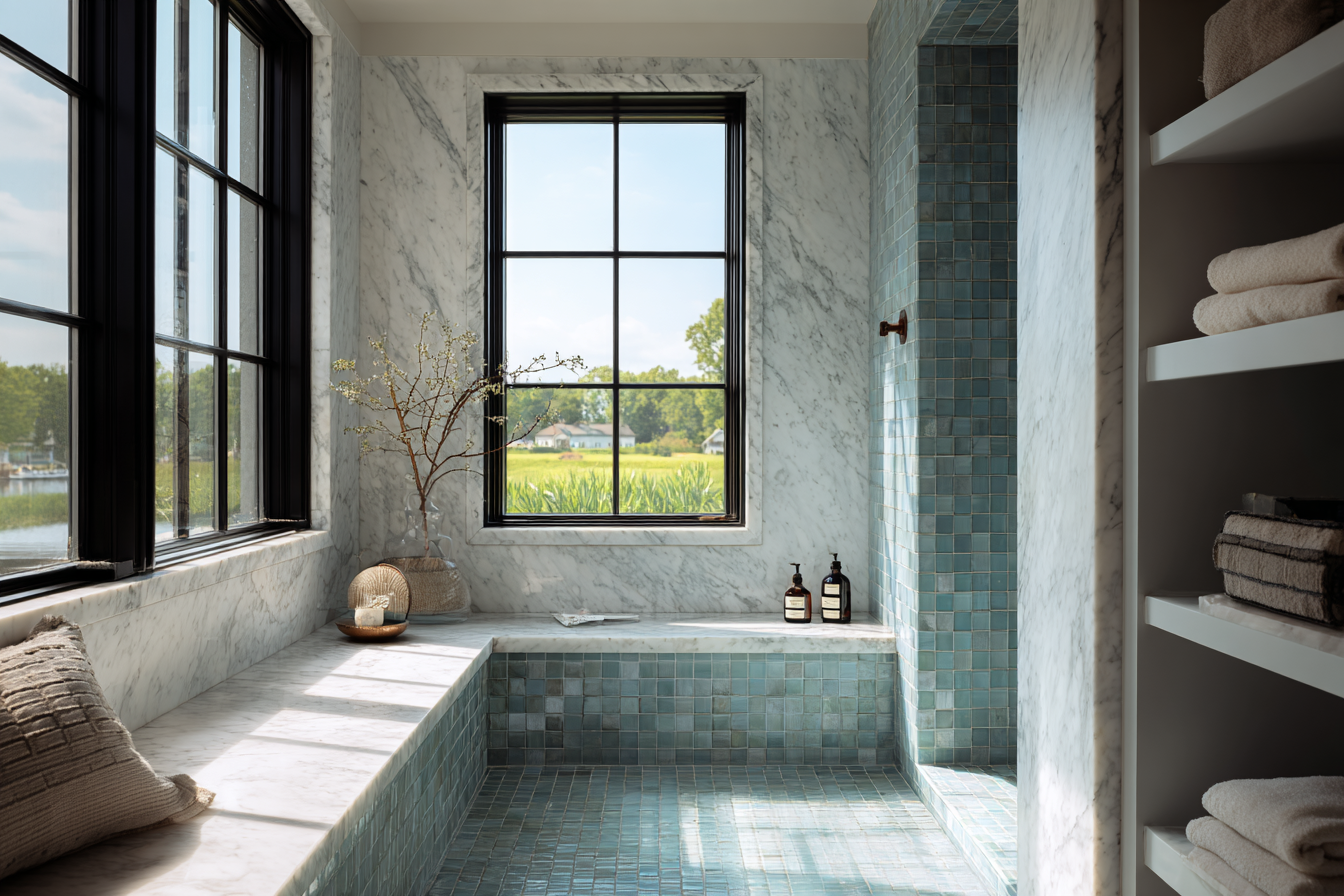
A walk-in shower in sea glass tile is the closest a bathroom comes to the ocean without being outside. The color, the water, the steam — the room becomes something the senses recognize as restorative. This is not an accident. The design is working. A shower you do not want to leave is a shower that is doing its job correctly. The tile earns that response. The room supports it.
The Palette
Sea glass — shower tile, the immersive element
White or light grey — surrounding bathroom, breathing room
Brushed brass or chrome — fixtures, hardware
Glass door — frameless, keeps the tile visible
Natural stone floor — pebble tile or honed marble
Mood & Feeling
The shower is the most private room within a private room. Its design matters in a way that is felt rather than seen — by the person using it, every single day. A shower in sea glass tile creates the sensation of being surrounded by clean water before the water turns on. That sensation, repeated daily, is not a small thing.
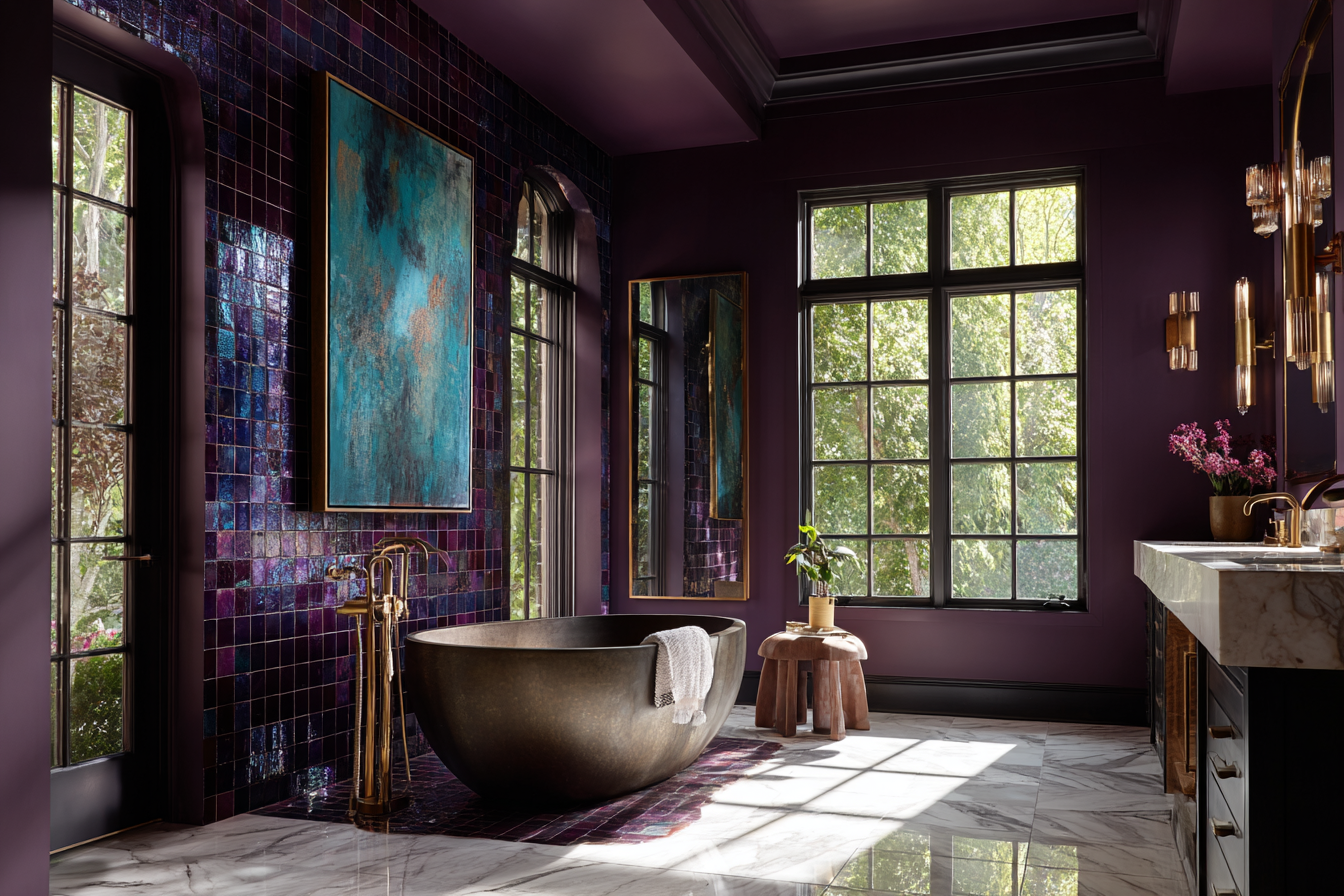
Deep Purple Glass Tile
Deep Purple Glass Tile
Brave Choice · Jewel Tone Bathroom · Better Than Yesterday
The Vibe
Deep purple glass tile is a bathroom that makes you feel like you made better decisions than you did yesterday. Not in a grand way — in the specific way of a room that greets you with something unexpected and beautiful. The jewel tone quality of glass tile catches light at angles that ceramic cannot. The room glows slightly. That glow, at seven in the morning, is a thing worth having in a room you begin your day in.
The Palette
Deep purple glass tile — the statement, earned fully
White marble — counter, floor, the necessary contrast
Polished chrome or brushed nickel — cool fixtures for cool tile
White fixtures — sink, tub
Minimal accessories — the tile is sufficient
Mood & Feeling
Purple is the color of considered luxury. Not the performative kind — the private kind, the kind that exists for the person who lives with it rather than for guests to notice. A deep purple bathroom is a room that treats the daily act of washing as something worth doing well. That is the correct attitude. The tile holds it.
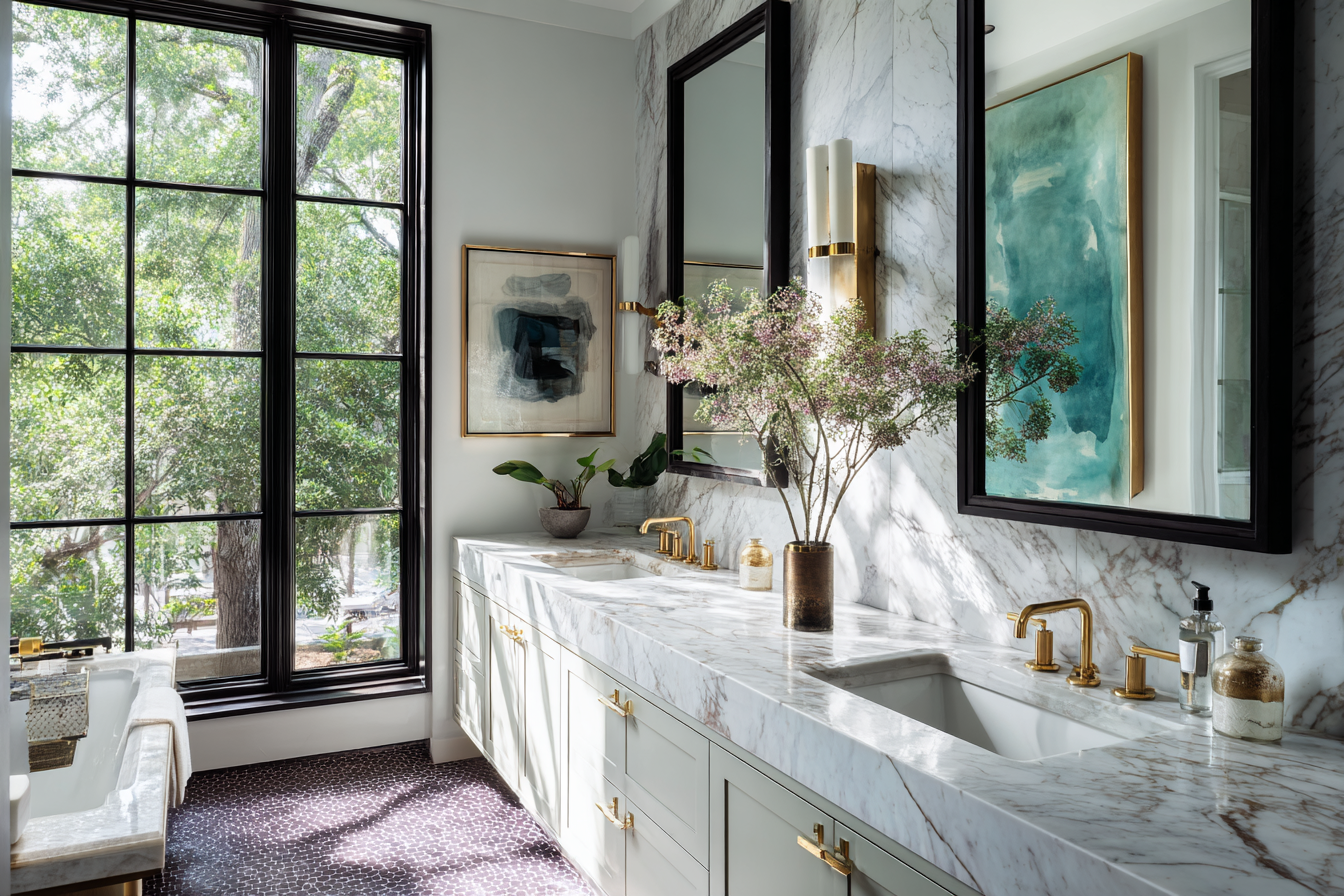
White Marble
White Marble
Timeless · The Standard · Nothing to Prove
The Vibe
White marble has been the correct choice in a bathroom for several thousand years. This is not a trend. It is a conclusion that has been tested by time and keeps passing. The veining moves the eye across the room without demanding attention. The white reflects light. The cold surface of the stone is part of the experience — cool in the morning, the cleanest thing in the room. A marble bathroom has nothing to prove. It simply is what it is.
The Palette
White marble — floor, walls, counter — all of it
White fixtures — continuous, seamless
Polished chrome — fixtures, the traditional pairing
One warm element — wood stool, brass mirror — prevents sterility
White towels — this room requires white towels
Mood & Feeling
The risk with an all-marble bathroom is sterility — a room so white and so hard that it feels clinical rather than luxurious. One warm element prevents this: a teak stool, an unlacquered brass faucet, a wooden mirror frame. One concession to warmth in an otherwise cold palette changes the room from a laboratory to a spa. That distinction is the whole design.
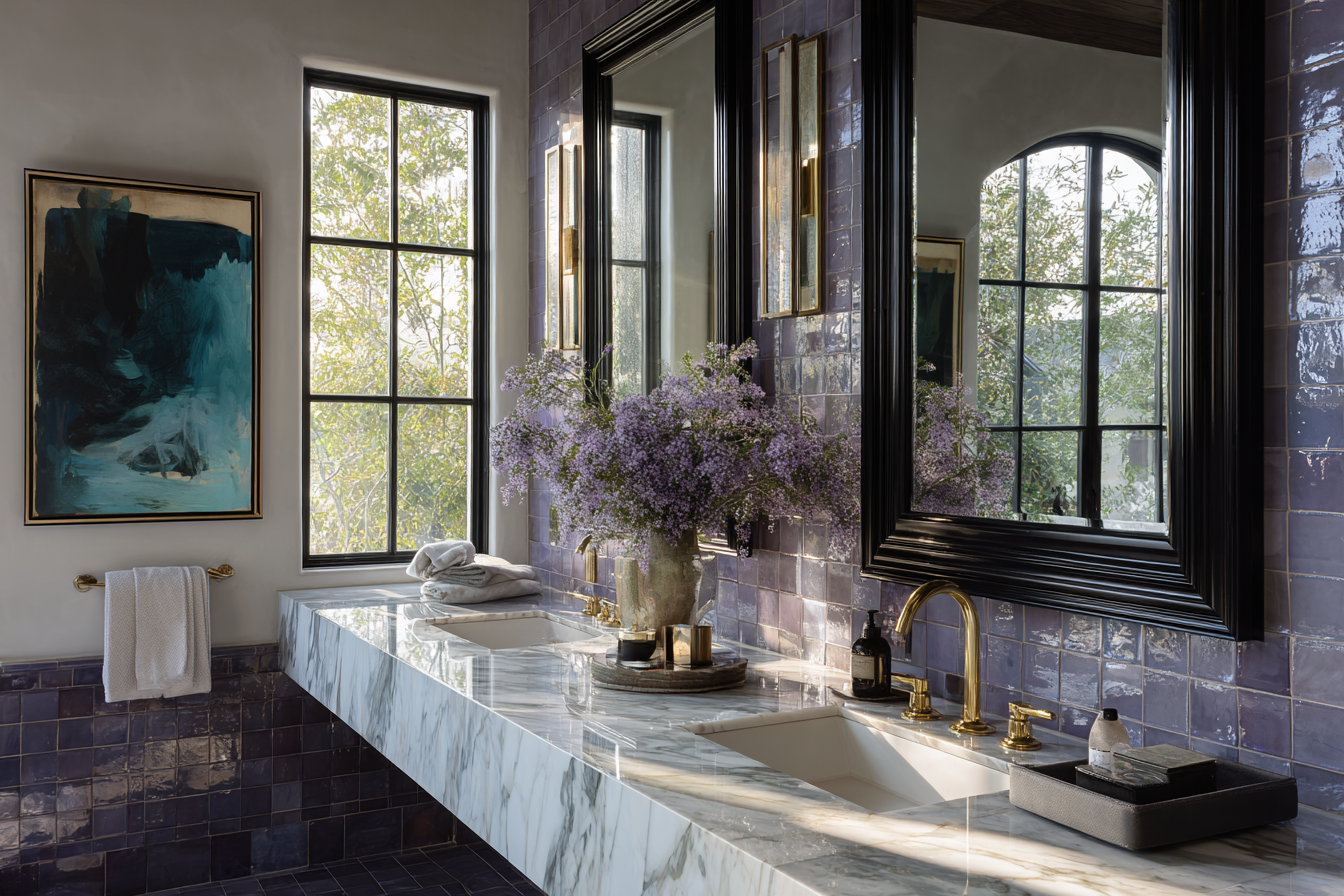
Glass Tile & Purple
Glass Tile & Purple
Jewel Box · Saturated & Luminous · The Room That Glows
The Vibe
Glass tile and purple together create a bathroom that glows from the inside. The glass catches light and returns it differently — warmer, more prismatic, more alive than ceramic. The purple gives the room depth and a specific kind of richness that reads as intentional rather than decorative. This is a jewel box of a bathroom. Small or large, it holds the light the way a gemstone does. That quality is rare and worth having.
The Palette
Purple glass tile — primary surface, the entire statement
White or very light grey — everything else, maximum restraint
Polished fixtures — chrome or silver, cool against the warm tile
White fixtures — sink, tub, clean contrast
No pattern elsewhere — the tile is already a pattern
Mood & Feeling
A room that glows creates a different experience than a room that is simply well-lit. The light in a glass tile room is alive — it changes as you move, as the time of day changes, as the steam fills the room. That living quality of light is what separates a bathroom that functions from a bathroom that restores. This one restores.
Outlaw Series — Cigarillo
Outlaw Series — Cigarillo
Point of View · Leather & Dark Wood · The Room Has Opinions
The Vibe
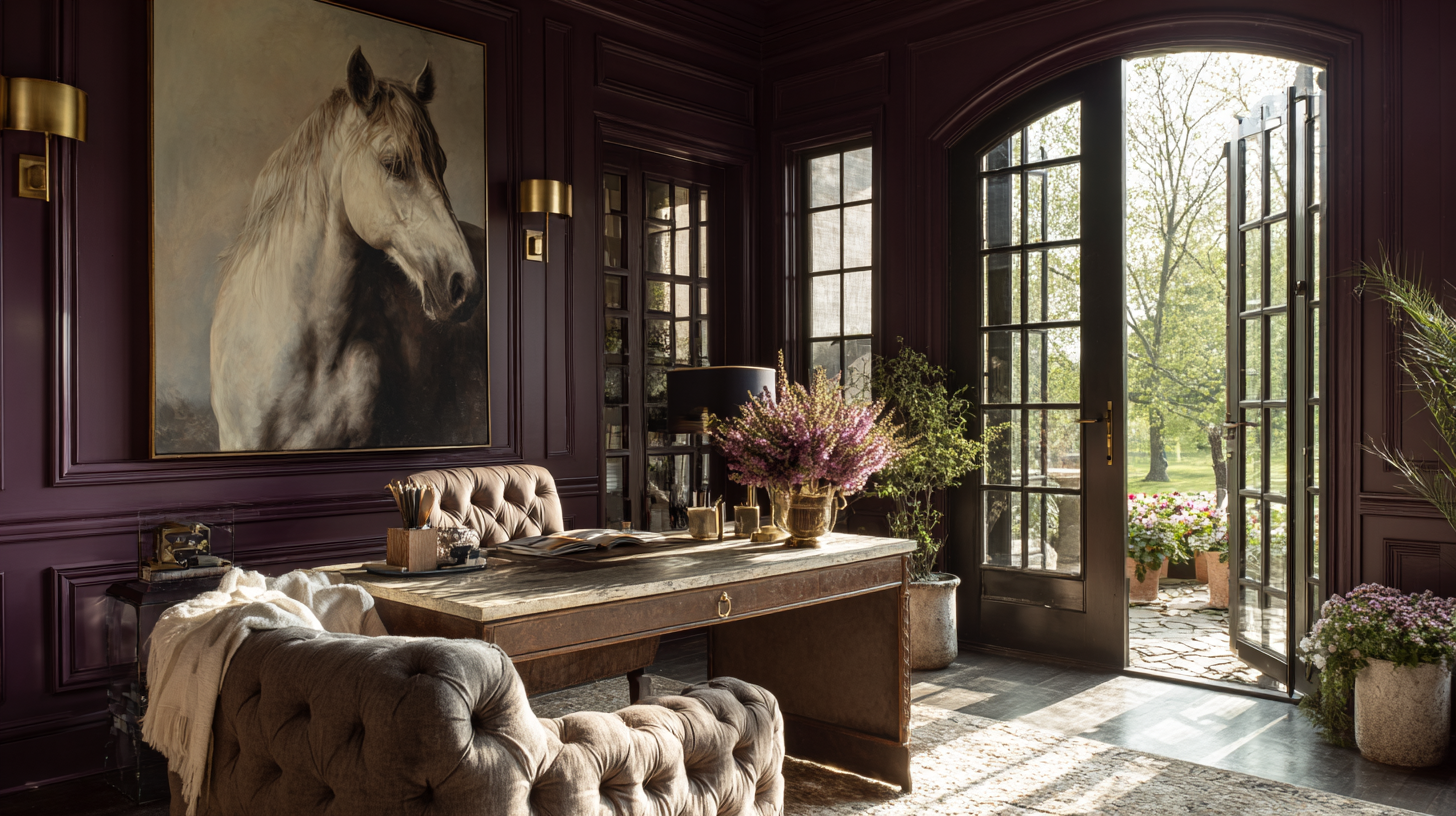
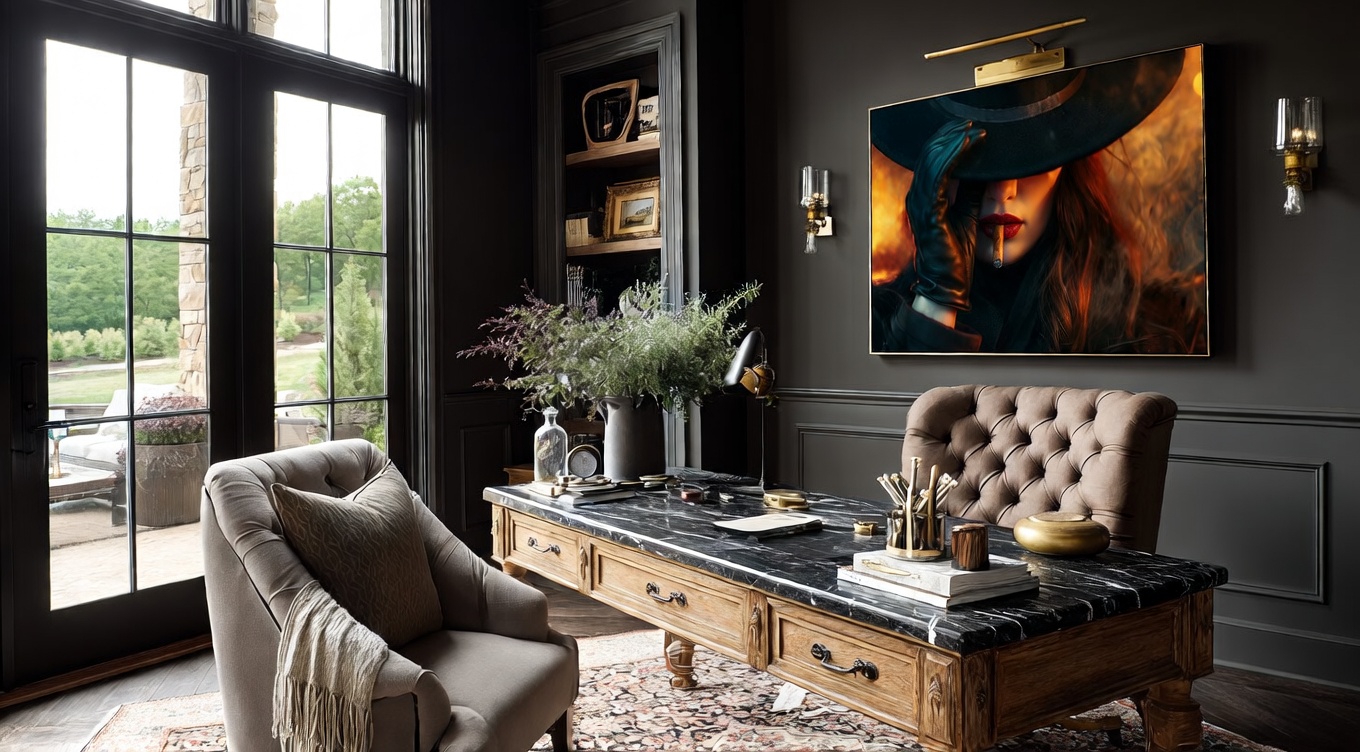
The Outlaw Series cigarillo above the desk is a room announcing its point of view before you sit down. That is correct. An office should have an opinion. It should tell you something about the person who works in it — what they value, how they think, what kind of work happens here. The art does that immediately. The rest of the room builds the case. Leather. Dark wood. A lamp that pools light rather than floods it. This is a room for thinking.
The Palette
Deep charcoal or dark espresso — walls
Aged cognac leather — chair, desk mat
Dark walnut — desk, shelving
Ember gold — lamp, frame detail
Cream — ceiling only, the one concession to lightness
Mood & Feeling
Dark offices are focused offices. The brain turns inward in a dark room — which is exactly the direction it needs to go for serious work. Warm lamp light in a dark room creates the feeling of working by firelight, which humans have been doing to productive effect for a very long time. The room is not moody. It is purposeful. There is a difference.
Deep Brick Red
Deep Brick Red
Warm Command · High Energy · The Productive Room
The Vibe
Deep brick red is a color that creates urgency without anxiety. It is warm, grounding, and specifically energizing in a way that most colors are not. A brick red office is a room that makes you want to work. Not because it demands anything of you — because the color itself signals activity, movement, production. This is a room built for output. The color is doing structural work before you arrive.
The Palette
Deep brick red — walls, the anchor
Cream and warm white — trim, ceiling, relief
Dark wood — desk, shelving, furniture
Aged brass or bronze — hardware, lamps
Leather — chair, desk mat, aged and warm
Mood & Feeling
Red increases heart rate and creates a mild sense of urgency. In a room where work needs to happen that is useful. Brick red specifically — darker, earthier, less aggressive than true red — delivers that energy without the edge. It is the difference between motivated and stressed. This room is motivated.
Bright Plum
Bright Plum
The Uncommonly Brave Choice · Creative Room · Original
The Vibe
Most people would not choose bright plum for an office wall. That is exactly why you should. A plum office makes a specific claim about the person who works in it — that they are not afraid of color, that they trust their own eye, that they understand that a creative room should feel like one. Plum is both warm and cool at the same time, which creates a kind of visual tension that the brain finds stimulating. Stimulating is good in a work room.
The Palette
Bright plum — walls, the commitment
Warm white — ceiling, trim, necessary contrast
Dark wood — desk, shelving, grounding
Gold or brass — hardware, warm against the cool plum
Cream or ivory — chair upholstery, neutral against the wall
Mood & Feeling
Creative professionals consistently report higher output in rooms with saturated color than in beige or grey rooms. The brain responds to saturated color as signal — something is happening here, something is being made. Plum is that signal in a warm, sophisticated key. The room feels alive without feeling chaotic. That is the creative sweet spot.
Charcoal Walls
Charcoal Walls
Total Focus · Inward · The Work Happens Here
The Vibe
Charcoal walls in a study are not depressing. They are focused. The brain operates differently in a dark room — it goes inward, which is the correct direction for an office. Distractions recede. The screen is brighter. The lamp is warmer. The work in front of you is the entire room. Paint it charcoal and stop second-guessing it. The room will thank you in productivity.
The Palette
Charcoal — walls, full and committed
Warm white — ceiling, trim, relief
Warm leather — chair, desk mat
Brass or gold — lamp, hardware, the essential warmth
Art — one strong piece that pops against the dark
Mood & Feeling
Dark walls make the things in front of you more vivid — the screen, the page, the task. They eliminate the peripheral distraction that lighter rooms create. This is a room that asks you to pay attention to what is on your desk. Most of the time that is exactly the right ask.
Moody Study
Moody Study
Low Light · Deep Tone · The Thinking Room
The Vibe
A moody study is a room where thinking happens slowly and well. The low light is not a failure of illumination — it is an intentional condition. The deep tones on the walls pull the space inward. The books, the objects, the singular lamp — everything exists in its own pool of light. This is a room built for the kind of concentration that requires you to be slightly removed from the world. It delivers that without effort.
The Palette
Deep neutral — charcoal, slate, or dark greige
Warm mahogany or dark walnut — shelves, desk
Aged leather — chair, well worn
Amber lamp — the only required light source
Books — their spines provide all other color
Mood & Feeling
The moody study is a room that respects solitude. It does not try to be cheerful or bright or welcoming in the conventional sense. It is welcoming in the specific sense — to the person who needs to think, to write, to solve something difficult. That kind of welcome is more valuable than the other kind.
Moody Office
Moody Office
Dark & Deliberate · Command Room · Serious Work
The Vibe
Some work requires a room that means business from the moment you walk into it. This is that room. Dark, deliberate, organized around the work rather than around comfort. The lamp does not illuminate the whole room — it illuminates the desk. That is the point. The rest of the room is background. The work is foreground. The room has made that prioritization for you and you should be grateful for it.
The Palette
Very dark wall — near black, absolute focus
Dark furniture — continuous with the walls, room reads as one
Warm task lighting — the only color in the room
Leather or dark textile — chair
Minimal objects — the room does not tolerate clutter
Mood & Feeling
Near-black rooms create a sensation of being inside the work rather than beside it. The peripheral vision has nothing to report. All available attention goes to the task. This is the room for the deadline, for the difficult conversation that needs to be written, for the problem that requires the full weight of the mind. It delivers.
Evening Sitting
Evening Sitting
Between House & Prairie · The Day That Is Not Quite Done
The Vibe
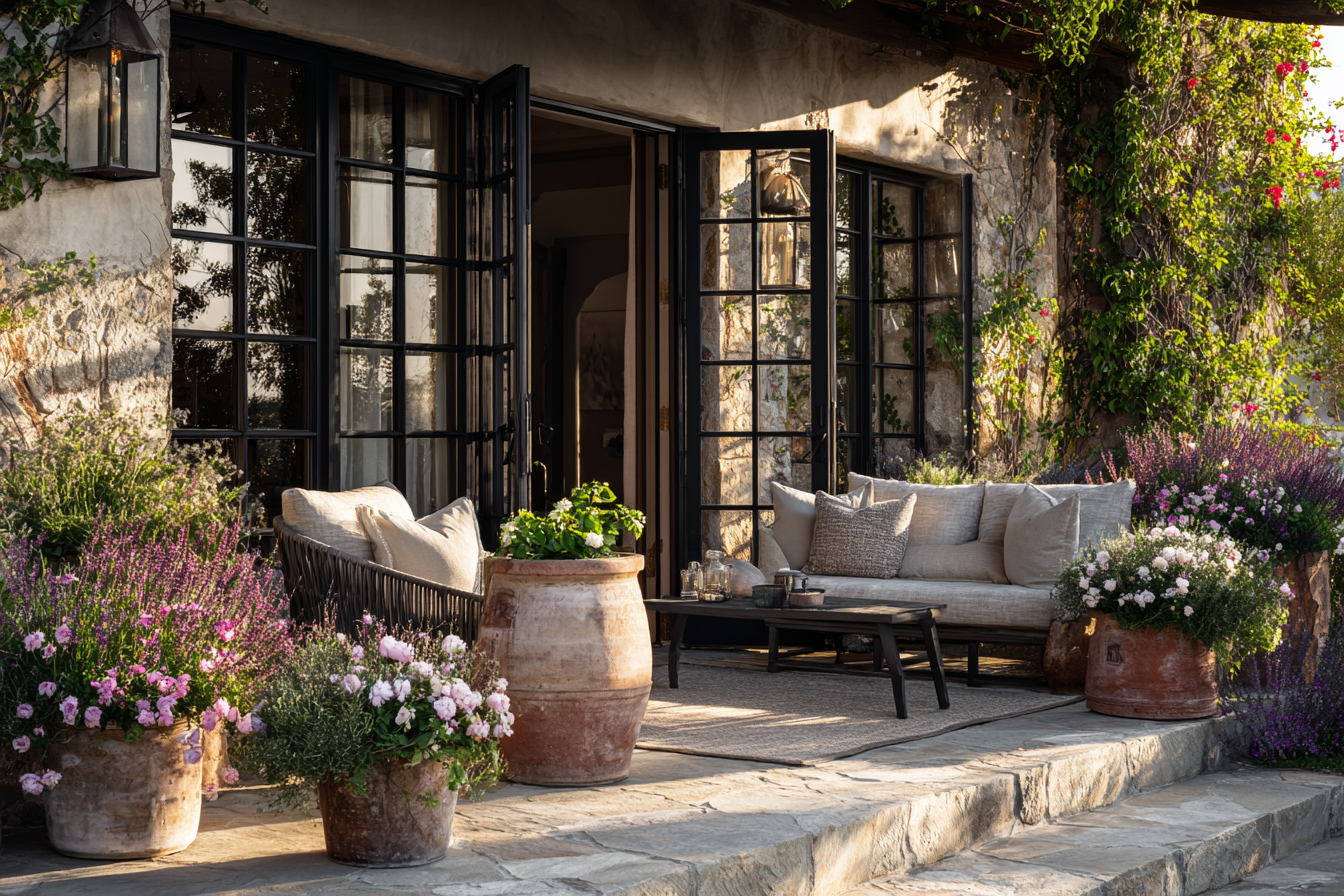
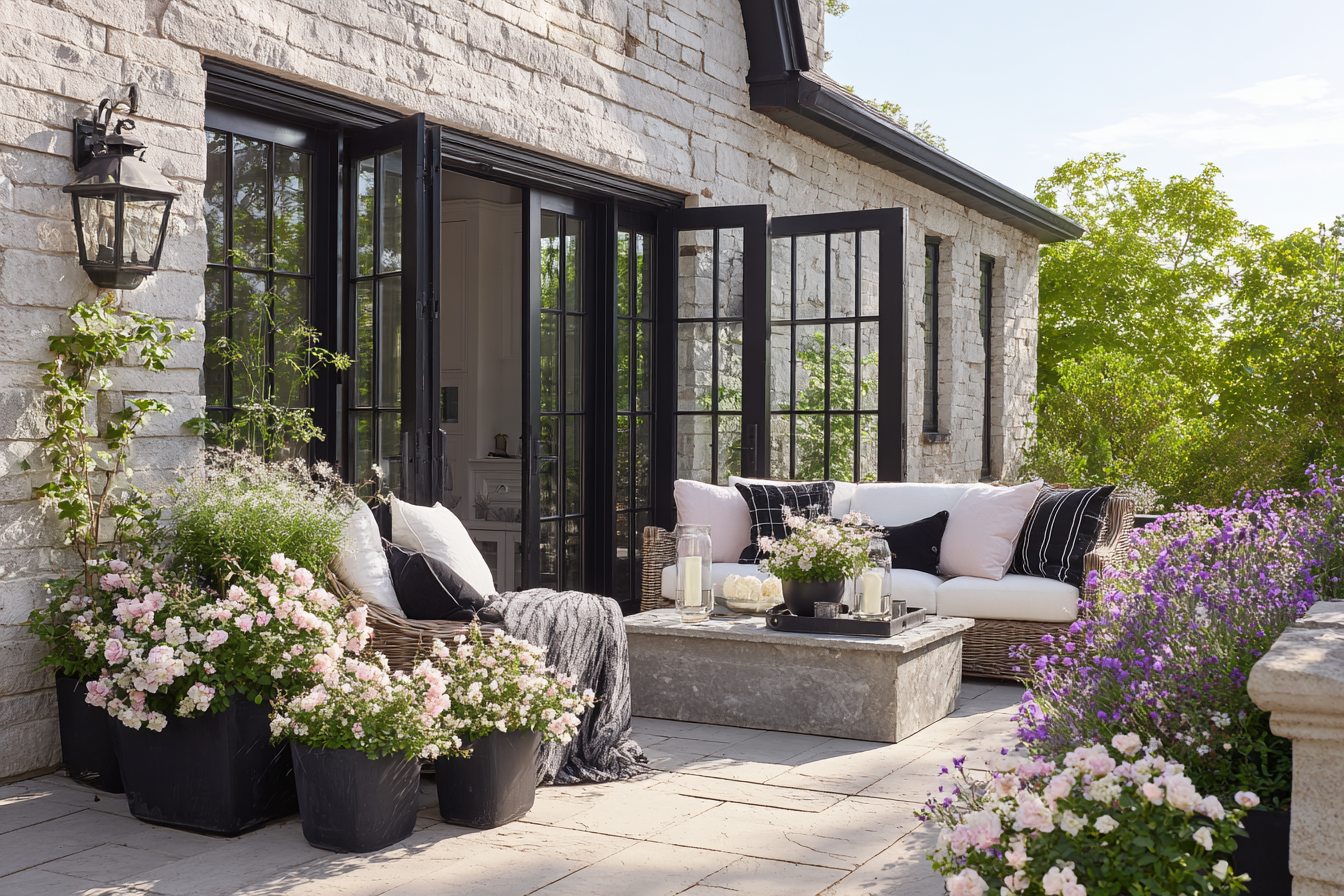
The veranda is where the evening goes when the day is done and not quite ready to be over. The sitting area faces the light as it leaves — the particular gold of a High Plains sunset that is worth staying outside for. The seating is arranged for conversation but tolerates silence equally well. A veranda like this does not need to be grand. It needs to be correctly placed to catch what the prairie offers at the end of the day. This one is.
The Palette
Deep wicker or wrought iron — furniture, weather-honest
Cream or linen cushions — the textiles take the light
Warm wood — floor planks or decking
The sunset — the palette arrives every evening and leaves on its own schedule
Candle or lantern light — for after the sun goes
Mood & Feeling
A veranda facing west on the High Plains is one of the great privileges of living here. The sky at sunset is not subtle and it is not the same twice. The furniture should be comfortable enough to stay in for two hours. The cushions should be light enough to read the colors of the light as they change. Everything else is secondary to the view.
Off the Bedroom
Off the Bedroom
Private Threshold · Morning & Night · The Personal Exterior
The Vibe
A veranda off the bedroom is the most private kind of outdoor space. It is not for guests — it is for the morning coffee before the day begins and the night air before sleep. It belongs to the bedroom the way a reading chair belongs to a library. It is an extension of the room's purpose: rest, privacy, the particular quiet of a space that is yours before and after everything else. The design should honor that intimacy.
The Palette
Natural materials only — wood, stone, wicker
Cream or white — cushions, simple and clean
One good chair — or two, but no more
Minimal lighting — one lantern or string light
Plants — if the climate allows, something green
Mood & Feeling
The private veranda works because it has one purpose — to extend the bedroom's atmosphere into the open air. It should not be social. It should not be furnished for dinner. It is a threshold space: the place between the inside room and the outside world, belonging fully to neither and offering the best of both.
The Sunroom
The Sunroom
Glass & Light · A Philosophy Not a Season · Living Room for the Outside
The Vibe
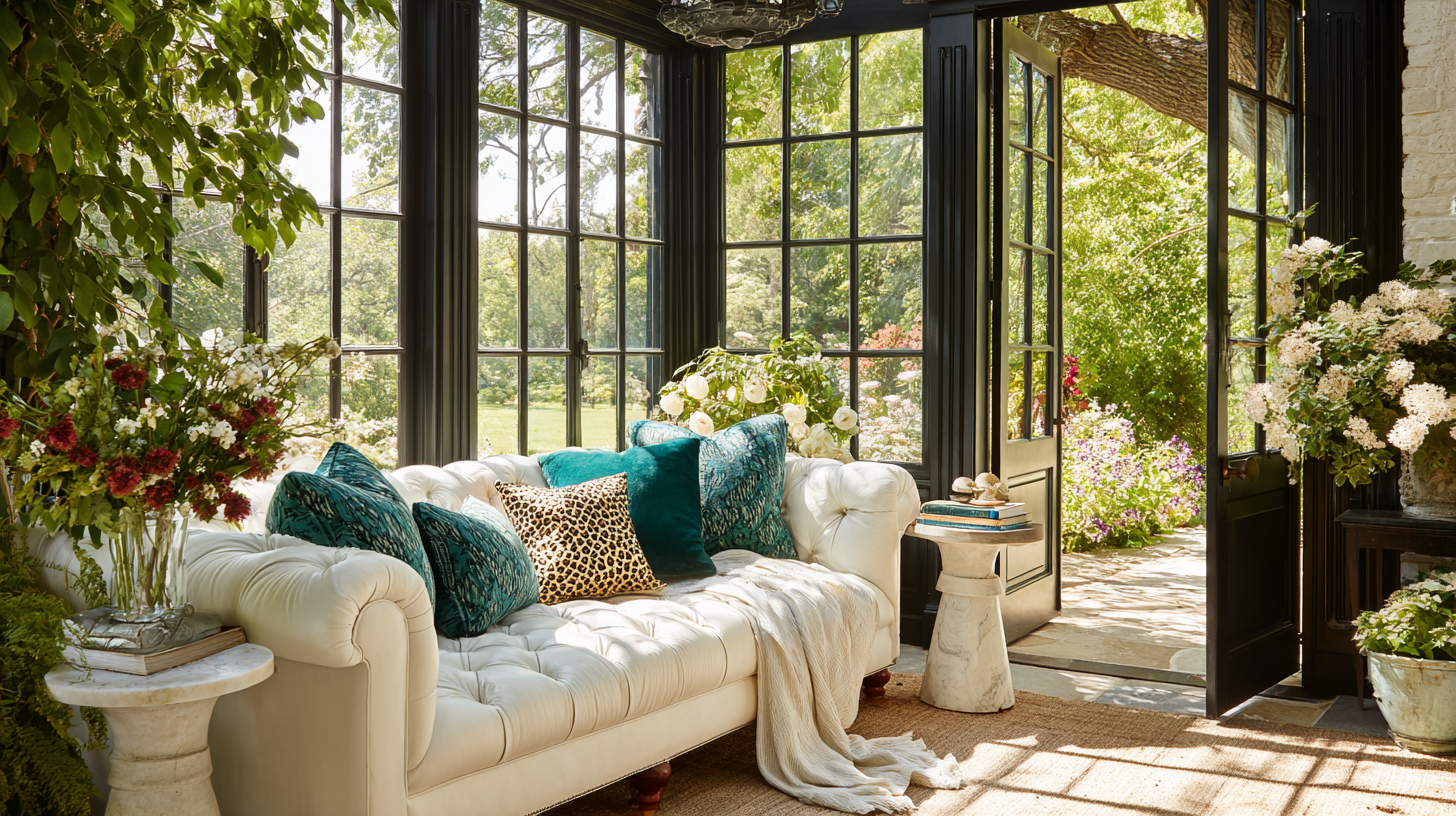
A sunroom is not a season. It is a philosophy about what a room should be — all light, all view, all the outside brought in without the inconvenience of weather. On the High Plains a sunroom in January is survival. In May it is indulgence. In August it requires a ceiling fan and no apology. The plants are real and they require attention and that is correct. The sunroom is a living thing. It asks something of you every morning in return for what it gives.
The Palette
Antique black — iron furniture, the right frame for the light
Faded sage linen — cushions, soft against the iron
Terracotta — pots, floor tile, the earth tone anchor
White painted trim — frames the glass, keeps it clean
Living green — the plants are the palette
Mood & Feeling
Sunrooms create mood through light rather than color. The design should step aside and let the light lead. Iron furniture in antique black is correct because it holds up to the bleaching effect of constant sun and looks better for the wear. Linen cushions that fade slightly are correct for the same reason. The room should age honestly into its purpose.
Charcoal & Command
Charcoal & Command
Decisions Get Made Here · Dark & Deliberate · Stay a While
The Vibe
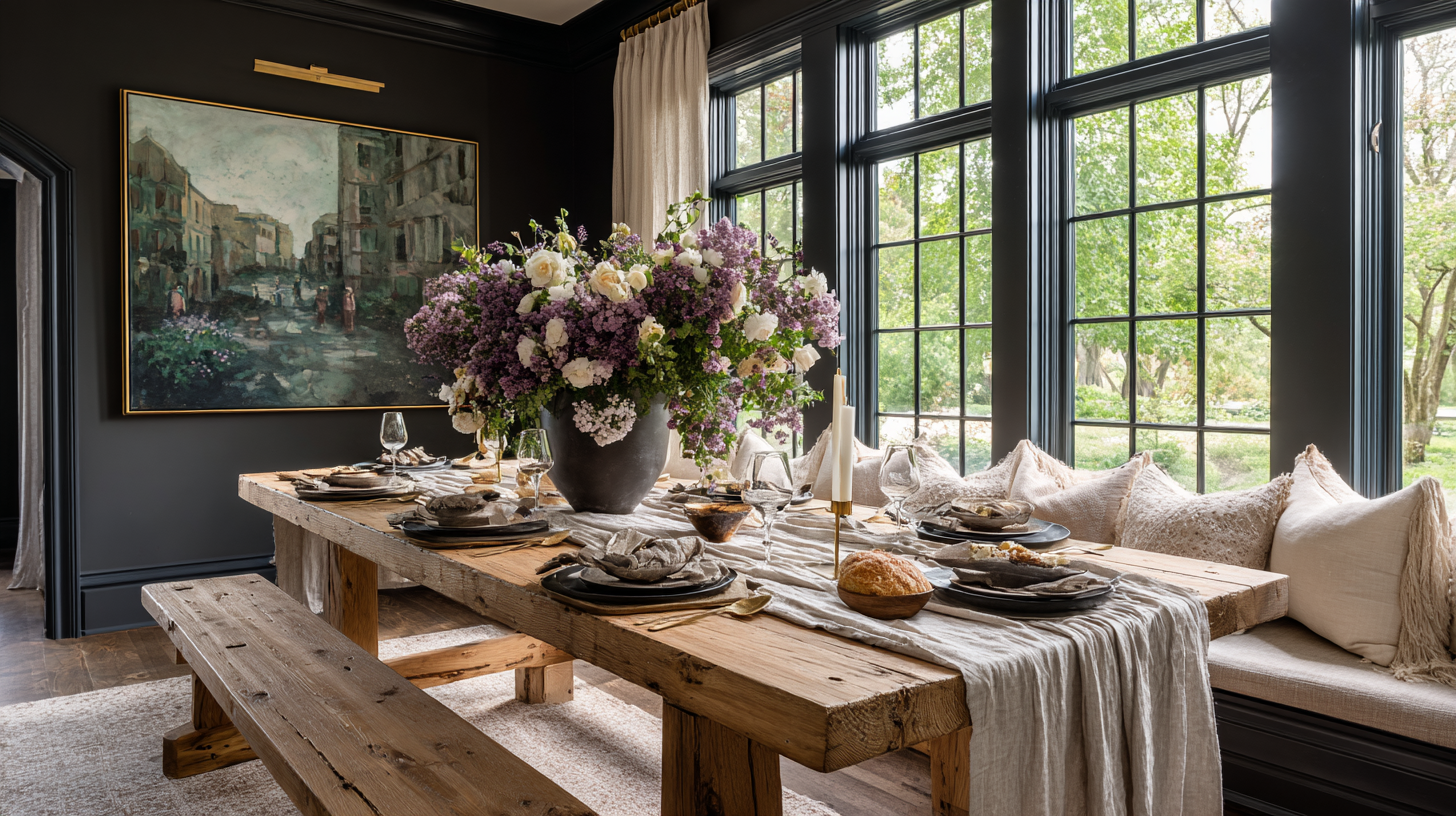
Charcoal walls and a long table that means business. This is the room that decides what kind of household this is. Not a room for hovering — a room for sitting down and staying. Things get said here, decisions get made, and the wine is poured correctly. The charcoal does something specific to the dining experience: it makes the candlelight matter more, makes the table feel more intimate, makes the conversation feel contained and consequential. A dining room should do that. This one does.
The Palette
Charcoal — walls, deep and commanding
Warm white — ceiling, trim
Dark walnut — table, the anchor of the room
Cream or linen — chairs, upholstery
Brass candlesticks and fixtures — warm light only, no overhead glare
Mood & Feeling
The art on the wall of a dining room must be strong enough to hold its own against a conversation. This is a high standard. Most art at a dinner table goes unnoticed. The right piece gets mentioned. The right piece changes the mood of the meal slightly and no one is entirely sure why. Choose accordingly. The charcoal wall makes whatever you hang on it more significant. Use that.